28 Oct 2026
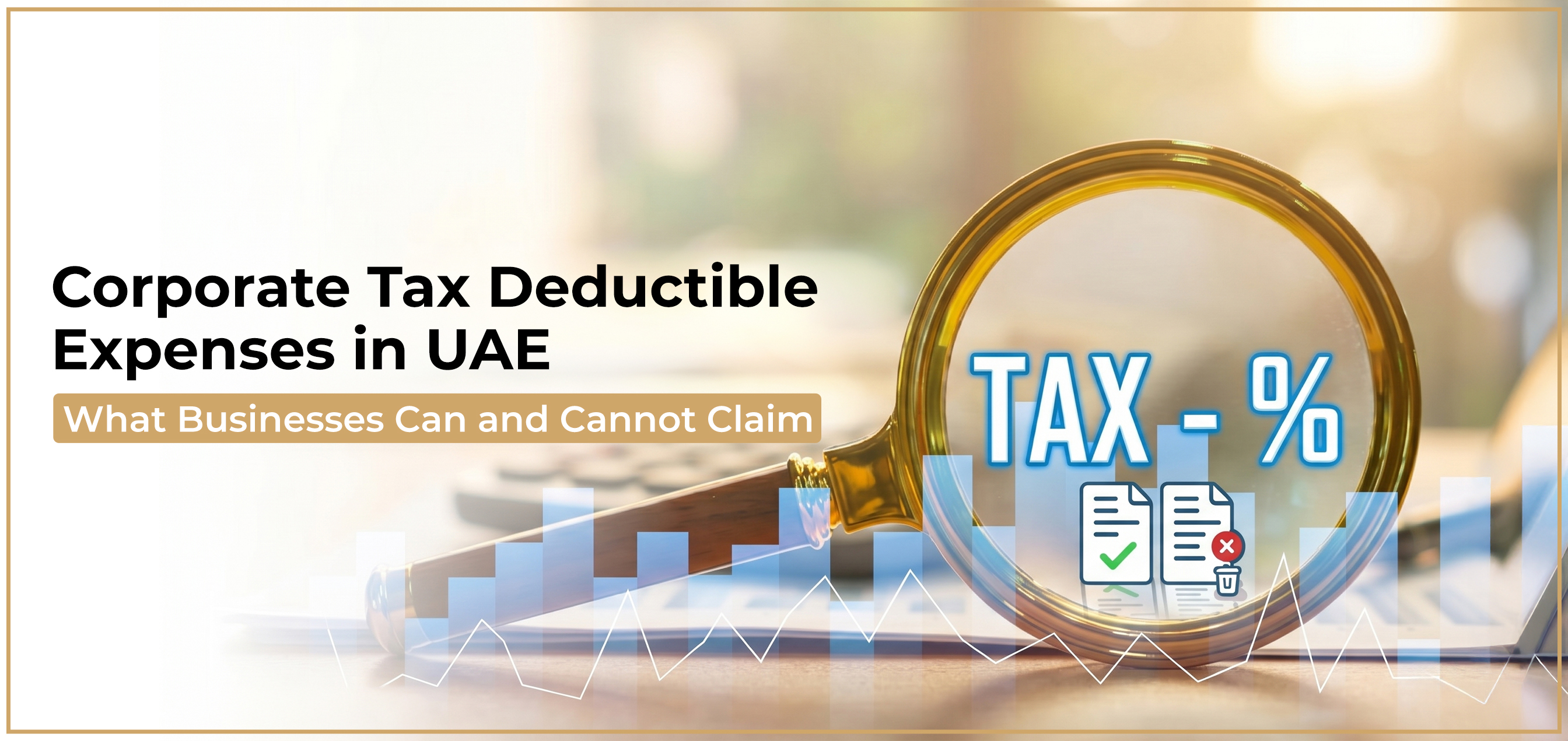
Since UAE Corporate Tax came into force for financial years starting on or after 1 June 2023, one question keeps landing in every finance team's inbox: which costs actually reduce your taxable income, and which ones don't? Getting this wrong is not a small clerical slip — it directly inflates or deflates your Corporate Tax Payable and can trigger FTA penalties if disallowed items are claimed. This guide breaks down corporate tax deductible expenses UAE rules in plain language, based strictly on Federal Decree-Law No. 47 of 2022 on the Taxation of Corporations and Businesses (the "UAE CT Law," effective from 1 June 2023) and the Federal Tax Authority's official guidance, so you know exactly where your business stands.
Reviewed by AMCA Auditing's Corporate Tax advisory team — AMCA is registered with the UAE Ministry of Economy and Tourism as a Licensed Auditor to operate as a Licensed Auditor and has advised UAE businesses on Corporate Tax compliance since the regime came into force in 2023. Sourced directly from the Federal Tax Authority's Corporate Tax legislation page and the FTA's official Corporate Tax guides listed under References below.
Disclaimer: This article provides general information on UAE Corporate Tax deductibility rules and does not constitute tax, legal, or financial advice. Deductibility often depends on the specific facts of a transaction, so businesses should consult a qualified Corporate Tax consultant before relying on any treatment described here.
What Is the UAE Corporate Tax Law and What Governs Deductible Expenses?
Every deduction claim starts with knowing which law and which authority actually controls the rule — guessing here is where most businesses go wrong.
-
UAE Corporate Tax is governed by Federal Decree-Law No. 47 of 2022 on the Taxation of Corporations and Businesses (official Ministry of Finance PDF), effective for tax periods beginning on or after 1 June 2023.
-
The standard corporate tax rate UAE applies is 0% on taxable income up to AED 375,000 and 9% on taxable income above that threshold.
-
Expense deductibility is specifically addressed in Chapter Nine of the law, Articles 28 to 33, covering general deduction rules, interest expenditure, entertainment expenditure, and non-deductible expenditure.
-
The Federal Tax Authority (FTA) is the body responsible for administering, clarifying, and enforcing these provisions through official Corporate Tax Guides, decisions, and the EmaraTax platform.
-
A related decision, Ministerial Decision No. 126 of 2023 on the General Interest Deduction Limitation Rule, supplements Article 30, which caps net interest expenditure deductions at 30% of adjusted EBITDA. Net interest expenditure of up to AED 12 million in a Tax Period is deductible in full, regardless of the 30% limit.
-
Both laws remain current as of 2026; a 2025 amendment (Federal Decree-Law No. 28 of 2025) revised Article 44 on tax settlement order, but it left Articles 28–33 on deductible and non-deductible expenditure untouched.
Before any of this becomes relevant, your business needs to be correctly registered in the first place — AMCA's guide on how to register for Corporate Tax in Dubai, UAE walks through that process step by step.
What Expenses Are Deductible Under UAE Corporate Tax?
Before diving into categories, it helps to understand the single test the FTA applies to every expense claim, because it decides almost every borderline case.
-
Under Article 28, expenditure is deductible for Corporate Tax purposes only if it is incurred wholly and exclusively for business purposes and is not capital in nature.
-
Deductions are calculated from the accounting income reported under IFRS or IFRS for SMEs, then adjusted per the CT Law.
-
If an expense serves both business and personal purposes, only the portion that can be reasonably and fairly identified as business-related is deductible.
-
Where no clear split is possible, the FTA allows a proportionate deduction calculated on a fair and reasonable basis.
-
Losses that are not connected to the business, or expenditure incurred in generating Exempt Income, are automatically excluded from this test.
What Are Allowable Business Expenses Under UAE Corporate Tax Law?
Once an expense clears the "wholly and exclusively" test, most everyday operating costs qualify as allowable business expenses UAE authorities recognise without dispute.
-
Employee salaries, wages, bonuses, and end-of-service benefits directly tied to business operations.
-
Office rent, utilities, and facility maintenance costs for premises used in the business.
-
Depreciation and amortisation of business assets, computed per the method allowed under the CT Law and accounting standards.
-
Marketing, advertising, and legitimate business promotion costs.
-
Professional fees paid to auditors, tax agents, and legal advisors for business-related services.
-
Interest expenditure on business loans, subject to the General and Specific Interest Deduction Limitation Rules under Articles 30–31 and Ministerial Decision No. 126 of 2023.
-
Bad debts written off are generally deductible where the write-off is recognised in accordance with the applicable accounting standards and the expense meets the general deductibility requirements of Article 28 of the Corporate Tax Law, meaning it is incurred wholly and exclusively for the purposes of the Taxable Person’s business and is not capital in nature..
At a glance: common allowable business expenses UAE-based companies claim
Managing these categories well is really a planning exercise rather than a filing-time scramble — see AMCA's Corporate Tax planning strategies for Dubai-based businesses for a broader framework.

What Expenses Cannot Be Claimed Under UAE Corporate Tax?
Article 33 of the UAE CT Law sets out a specific list of non-deductible expenses that UAE businesses must add back to their accounting income. No exceptions are read into this list.
-
Donations, grants, or gifts paid to any entity that is not a Qualifying Public Benefit Entity approved by Cabinet Decision No. 37 of 2023.
-
Fines and penalties, except amounts paid as compensation for damages arising from breach of contract.
-
Bribes or other illicit payments made in the course of business.
-
Dividends, profit distributions, or similar benefits paid to owners or shareholders.
-
Amounts withdrawn from the business by a natural person who is a Taxable Person, or by a partner in an Unincorporated Partnership.
-
Recoverable input VAT, Corporate Tax itself, and taxes on income imposed outside the UAE.
-
In addition, under the general deductibility test in Article 28, any expenditure not incurred wholly and exclusively for business purposes is non-deductible, including personal expenses of the owner or connected persons.
At a glance: expenses you cannot claim under UAE corporate tax (Article 33)

Claiming any of these by mistake is exactly the kind of error that surfaces during an FTA review — see Why Audits Are Critical in Meeting UAE's Corporate Tax Filing Deadlines for how that plays out in practice.
What Is the List of Non-Deductible Expenses Under UAE CT Law?
Beyond the outright bans in Article 33, the law identifies several categories where deduction is deliberately restricted rather than fully denied. This is the disallowed expenses area of UAE CT law that catches most businesses off guard.
-
Excess interest expenditure: net interest above the higher of AED 12 million or 30% of adjusted EBITDA is disallowed in the current period but can be carried forward, under the General Interest Deduction Limitation Rule.
-
Related-party transactions: any cost that does not meet the arm’s length standard between Related Parties or Connected Persons is disallowed to that extent.
-
Expenditure incurred in deriving Exempt Income: for example, costs linked to a qualifying dividend or participating interest.
-
Expenses that fail the Article 28 test: any cost not incurred wholly and exclusively for business purposes is disallowed. For example, recreational club membership fees for employees that serve no legitimate business purpose.
-
Undocumented expenses: the FTA can disallow a claimed expense on audit if supporting invoices, contracts, or board approvals are missing. Under Article 56 of the CT Law, these records must be kept for 7 years after the end of the Tax Period they relate to.
Related-party costs and documentation gaps are also central to broader compliance readiness — AMCA's Corporate Tax compliance strategies in the UAE covers this in more depth.
Is Client Entertainment 50% Deductible Under UAE Corporate Tax?
Client entertainment sits in its own category under Article 32, and it is one of the most frequently misapplied rules in day-to-day bookkeeping.
-
Only 50% of entertainment, amusement, and recreation expenditure incurred to entertain customers, shareholders, suppliers, or other business partners is deductible.
-
Qualifying costs include meals, accommodation, transportation, and admission fees paid in connection with entertaining these parties.
-
The remaining 50% must be added back when computing taxable income, regardless of how the cost is booked in the financial statements.
-
Employee-related entertainment, such as staff parties, off-site events, and similar employee activities, is generally outside the Article 32 50% restriction and may be fully deductible where it satisfies the general business purpose requirements of Article 28.
-
Entertainment expenses that fail the "business purpose" test entirely — for example, personal leisure disguised as client hospitality — are 100% disallowed, not merely capped at 50%.
Entertainment is one of the most common questions AMCA fields from clients — see Corporate Tax in the UAE: Frequently Asked Questions for more everyday scenarios.
What Is the Difference Between Deductible and Non-Deductible Expenses in UAE?

The gap between what your accountant books and what the FTA accepts is exactly where most Corporate Tax adjustments happen, so it's worth separating the two concepts clearly.
-
An accounting expense is any cost recognised under IFRS in your financial statements, regardless of its tax treatment.
-
A tax-deductible expense is the subset of accounting expenses that also satisfies Articles 28–33 of the CT Law.
-
Deductible expenses reduce taxable income directly; non-deductible expenses must be added back to accounting income during the tax computation.
-
Capital expenditure is usually booked as an asset in accounting terms and recovered through depreciation, rather than deducted in full in the year incurred.
-
Timing differences (e.g., provisions booked for accounting purposes but not yet actually incurred) often create deductible vs non-deductible expenses UAE mismatches that require a tax reconciliation schedule.
This distinction matters even more for entities with special tax status — see AMCA's guide on Exempt Person status under UAE Corporate Tax for how deductibility interacts with exemption rules.
Why Should Businesses Work with a Corporate Tax Consultant in UAE?
Given how narrowly the FTA defines deductibility, most businesses benefit from a second set of expert eyes before filing.
-
A corporate tax consultant UAE businesses hire can map every ledger account against Articles 28–33 to flag disallowed items before filing.
-
Professional corporate tax advisory services Dubai firms provide help structure related-party transactions to meet arm's length requirements and avoid disallowance.
-
An experienced tax accountant UAE companies retain can maintain the documentation trail the FTA expects during a Corporate Tax audit.
-
Regular expense reviews reduce the risk of penalties for incorrect filings. These include a fixed AED 500 penalty for an incorrect Corporate Tax return and, where errors are not voluntarily disclosed before an FTA audit notice, a 15% penalty on the tax difference plus 1% per month, in addition to the tax due on any disallowed amounts.
-
Ongoing advisory support keeps your business aligned as the FTA issues new guides and Cabinet or Ministerial Decisions each year.
AMCA Auditing's Corporate Tax Services in UAE team works with businesses across every emirate to review expense claims before filing, structure related-party transactions correctly, and represent clients through FTA queries. Smaller entities weighing eligibility alongside their deductions may also want to check AMCA's guide on Small Business Relief in the UAE.
Conclusion
Corporate Tax deductions in the UAE are not a matter of interpretation — they follow a fixed structure under Federal Decree-Law No. 47 of 2022 and FTA guidance, and every claim needs to survive that test on audit. Getting it right protects your bottom line and keeps your filings penalty-free.
AMCA Auditing helps businesses across the UAE apply these rules correctly, from first registration through to annual filing.
-
Detailed review of your expense ledger against Articles 28–33 of the UAE CT Law.
-
Support with interest deduction limitation calculations and related-party documentation.
-
End-to-end Corporate Tax registration, filing, and FTA audit support.
-
Ongoing advisory to keep your deductions aligned with the latest FTA guides and amendments.
Visit the AMCA Auditing to explore the full range of audit, accounting, and tax services, or contact AMCA today to have your expense ledger reviewed by a qualified Corporate Tax consultant before your next filing.
FAQs
What expenses are deductible under UAE corporate tax?
Expenditure is deductible if it is incurred wholly and exclusively for business purposes and is not capital in nature, as set out in Article 28 of the UAE CT Law.
-
Salaries, rent, and utilities used for business operations.
-
Depreciation on business assets and professional service fees.
-
Interest expenditure, subject to the General and Specific Interest Deduction Limitation Rules.
What expenses cannot be claimed under UAE corporate tax?
Article 33 lists specific costs that can never be deducted, regardless of how they are recorded in the accounts.
-
Donations, grants, or gifts to entities that are not Qualifying Public Benefit Entities.
-
Fines and penalties (other than compensation for breach of contract).
-
Bribes or other illicit payments.
-
Dividends, profit distributions, or similar benefits paid to owners or shareholders.
-
Amounts withdrawn from the business by a natural person who is a Taxable Person, or by a partner in an Unincorporated Partnership.
-
Recoverable input VAT.
-
Corporate Tax itself, and taxes on income imposed outside the UAE.
Is client entertainment 50% deductible in the UAE?
Yes, only 50% of entertainment, amusement, or recreation expenditure incurred for customers, suppliers, shareholders, or other business partners is deductible under Article 32 of the UAE CT Law. The remaining 50% must be added back when calculating taxable income, and entertainment that fails the general business-purpose test can be fully disallowed rather than just capped.
How do I know if an expense is capital or revenue in nature for corporate tax purposes?
An expense is generally treated as capital in nature if it creates a lasting asset or benefit for the business beyond the current tax period, such as purchasing equipment, property, or intangible rights. Capital costs are not deducted in full immediately; instead, they are recovered over time through depreciation or amortisation in line with accounting standards and the CT Law. If you are unsure whether a cost should be expensed or capitalised, it is worth checking the treatment against your Financial Statements before filing your Corporate Tax return.
Do free zone businesses follow the same deductible expense rules as mainland companies?
Both mainland businesses and Free Zone Persons are subject to the same general deductibility conditions under Articles 28–33 of the UAE CT Law, including the wholly-and-exclusively test and the entertainment expenditure cap. However, a Qualifying Free Zone Person benefiting from the 0% rate on Qualifying Income must still track and separate expenses relating to non-qualifying income, since deductions are only relevant against income that is actually subject to the 9% rate. This makes accurate expense allocation especially important for free zone entities with mixed income streams.