28 Sep 2026
The UAE is preparing for one of the most significant tax reforms since VAT was introduced in 2018. With the rollout of the UAE's e-invoicing framework, businesses will move away from paper invoices, PDFs, and manual reporting toward a fully digital, standardised invoicing ecosystem.
Yes, e-invoicing is mandatory in the UAE, rolling out in phases from July 2026. It applies regardless of VAT registration status, and it changes VAT compliance from a periodic, document-driven process into a continuous, data-driven one — invoice data reaches the FTA electronically, in near real time, through an Accredited Service Provider.
This article is based on official Ministry of Finance and Federal Tax Authority guidance and is for general information only. Confirm your specific implementation date on the Ministry of Finance's e-invoicing portal or with a VAT compliance advisor, since deadlines are phased by revenue and entity type.
This transformation is more than a technology upgrade — it's a fundamental shift in how businesses manage VAT compliance UAE. Instead of submitting tax information periodically, invoice data will be exchanged electronically and reported to the Federal Tax Authority (FTA) in near real time, bringing faster reporting, improved transparency, reduced compliance risk, and greater efficiency. The Ministry of Finance (MoF) has designated its own e-invoicing portal as the primary source of information for the rollout, and implementation is phased by business revenue — so businesses should confirm the exact start date and deadlines that apply to them rather than assume a single date applies to everyone.
What Is E-Invoicing in the UAE?
Per the Ministry of Finance, an e-invoice is a structured electronic invoice created, exchanged, and reported digitally between suppliers, buyers, and the FTA. Unlike conventional invoices, e-invoices are machine-readable and follow standardised data formats that enable automated processing. Documents such as PDFs, scanned invoices, Word files, emails, or image-based invoices do not qualify as e-invoices under the UAE framework, because they lack structured data.
The UAE has adopted the Decentralized Continuous Transaction Control and Exchange (DCTCE) model, based on the internationally recognised OpenPeppol standard, with a national specification called PINT AE. This lets businesses exchange invoices securely while simultaneously reporting tax data to the FTA.
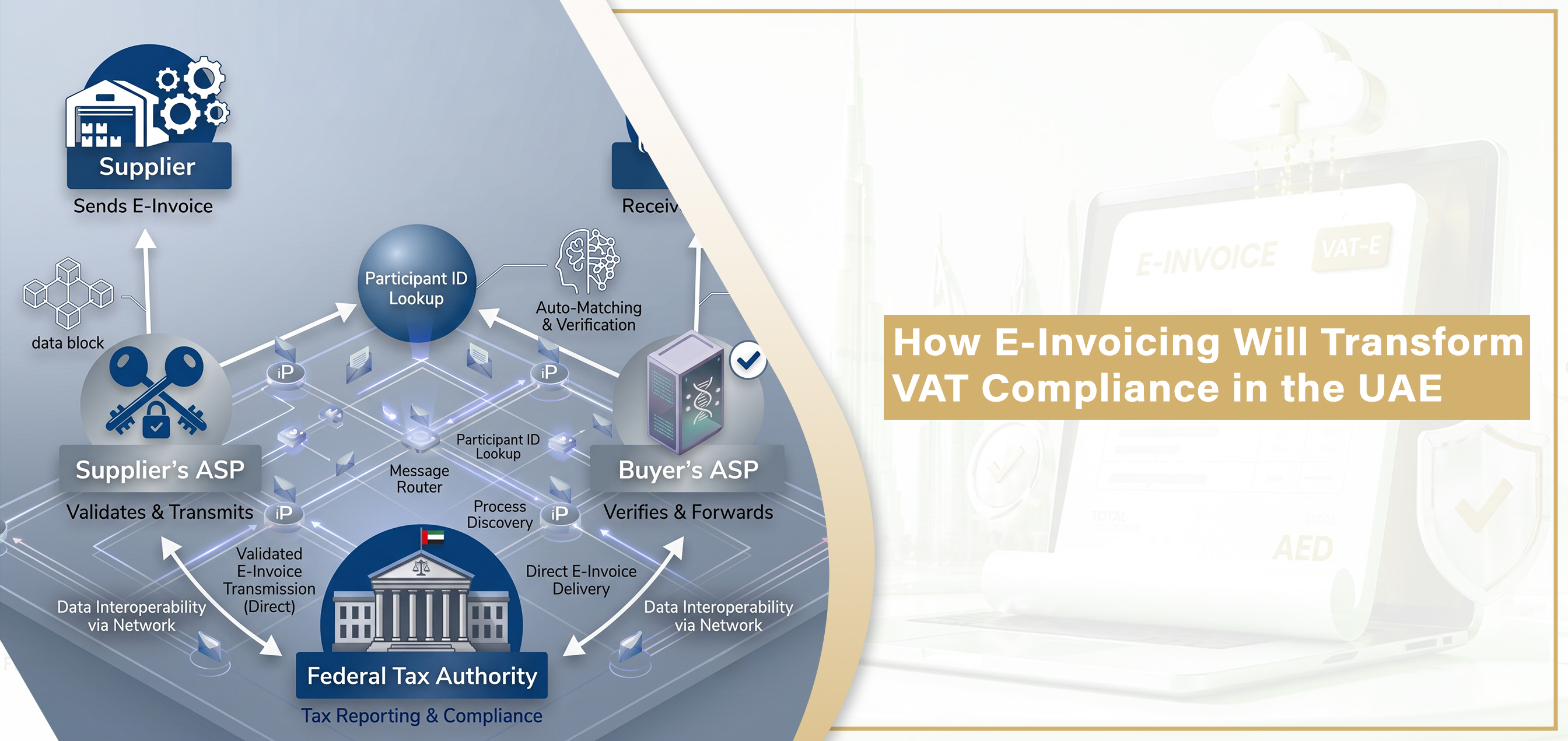
Under this "five-corner model":
-
The supplier creates an invoice through its accounting or ERP system.
-
The invoice is submitted to an Accredited Service Provider (ASP).
-
The ASP validates the invoice and converts it into the required XML format if necessary. It's worth being clear here: even though the ASP helps convert or send invoices correctly, it isn't responsible if something goes wrong with your taxes — the business remains fully legally responsible for complying with tax rules and keeping accurate records.
-
The validated invoice is transmitted electronically to the buyer's ASP, while the relevant tax data is reported to the FTA.
-
Validation confirmations are shared with both parties.
This replaces the traditional process of submitting VAT information only during periodic tax returns with near real-time reporting.
How Will E-Invoicing Change VAT Compliance?
Improved VAT accuracy. Invoice data is validated electronically before reaching the buyer and the FTA, reducing manual errors, duplicate invoices, and incorrect VAT calculations.
Reduced VAT leakage. One of the Ministry's key objectives is reducing VAT leakage from reporting errors, omissions, or fraud. Near real-time invoice data gives the FTA better tax monitoring and helps ensure broader compliance.
Simplified VAT filing. Because invoice information flows through ASPs, VAT returns are expected to become more streamlined, with the Ministry indicating certain return fields may eventually be pre-populated — speeding up refund processing.
Faster payments and better cash flow. Standardised formats and automated validation cut disputes from invoice errors, so invoices go out faster, get received faster, and payment cycles shorten.
Better business insights. Structured digital data supports better financial reporting and analytics, helping businesses monitor transactions, spot trends, and reduce administrative workload.
Enhanced data security. Secure electronic transmission and encrypted data exchange reduce the risk of document manipulation, fraud, and unauthorised access.
Overall, e-invoicing turns VAT compliance from a manual, document-driven process into a continuous, automated, data-driven one. Even where returns are partly pre-populated, the taxpayer remains fully responsible for reviewing and confirming the accuracy of the final VAT return before submission — pre-population simplifies the process, it doesn't shift the compliance burden. AMCA's VAT return filing service can help you build that review step into your process from day one, and our guide on how risk-based auditing helps with Corporate Tax and VAT compliance covers how continuous data flows change what auditors and the FTA look for.
Is E-Invoicing Mandatory in the UAE?
Yes. Per official Ministry of Finance and FTA guidance, e-invoicing will be mandatory for businesses conducting commercial activities in the UAE, regardless of VAT registration status, unless specifically exempted. Implementation is phased:
-
1 July 2026 — Pilot programme underway for selected taxpayers; voluntary early adoption open to all businesses.
-
1 January 2027 — Mandatory for businesses with annual revenue of AED 50 million or more. These businesses must appoint an Accredited Service Provider beforehand — originally due by 31 July 2026, this ASP deadline was later extended to 30 October 2026.
-
1 July 2027 — Mandatory extends to businesses with annual revenue below AED 50 million (ASP appointment required by 31 March 2027).
-
1 October 2027 — Mandatory for in-scope government entities (ASP appointment also required by 31 March 2027).
Non-compliance carries real cost. Under the Cabinet Decision on Violations and Penalties for the Electronic Invoicing System, failing to implement the system carries a fine of AED 5,000 per month (or part thereof) of delay, while failing to report system malfunctions or unauthorised data modifications within the prescribed timelines carries a further AED 1,000 per day of delay.
Who Needs to Implement E-Invoicing?
One of the most important parts of the UAE framework: e-invoicing isn't limited to VAT-registered businesses. It applies to any person conducting commercial activity in the UAE unless specifically excluded — the implementation timeline depends on revenue, not VAT registration status.
Tax Identification Number (TIN)
A Tax Identification Number (TIN) is a unique identification number assigned to a taxpayer for tax administration and identification purposes. It is used to identify the taxpayer in dealings with the relevant tax authority and should not be confused with a Tax Registration Number (TRN). For businesses already registered for VAT or Corporate Tax, the TIN is derived from the first 10 digits of the 15-digit TRN. Businesses in scope of e-invoicing but not registered for any FTA tax are issued a TIN separately, so they can still be identified in the e-invoicing system.
Tax Registration Number (TRN)
A Tax Registration Number (TRN) is the number issued by the UAE Federal Tax Authority (FTA) when a business is registered for a specific tax, such as Value Added Tax (VAT) or Corporate Tax. The TRN is used for tax filings, returns, correspondence with the FTA, and other tax-related compliance requirements.
Businesses registered for VAT or Corporate Tax can access their tax registration details and related services through their EmaraTax account.
Eligibility and system requirements — to comply, businesses should:
-
Have a valid Tax Identification Number.
-
Select and onboard an Accredited Service Provider.
-
Upgrade accounting or ERP systems to support structured invoice formats.
-
Follow the Ministry of Finance's mandatory invoice data requirements.
-
Meet the technical specifications under the UAE's PINT AE standard.
Early preparation avoids implementation problems as the mandatory deadlines approach — our accounting and bookkeeping team can assess ERP readiness alongside your VAT compliance position, and our piece on how AI and automation are changing accounting in the UAE is useful background on the systems side of this shift.
Key Benefits of UAE E-Invoicing
Lower processing costs. The Ministry of Finance states that e-invoicing can reduce invoice processing costs for businesses and governments by up to 66% — largely by eliminating manual data entry and paper-based processes.
Greater efficiency. Automated creation, validation, and exchange cut administrative work while improving accuracy and processing speed.
Faster business transactions. Electronic delivery removes delays from manual approvals and document handling, enabling quicker payment cycles.
Improved international compatibility. Because the UAE has adopted the OpenPeppol framework, businesses are better positioned to exchange invoices with trading partners in other countries on the same international standard.
Support for digital transformation. The initiative aligns with the UAE's wider digital economy strategy — less paper, more automation, more efficient tax administration.
How Should Businesses Prepare?
Start well before your mandatory implementation date. Businesses with annual revenue of AED 50 million or more must appoint a UAE Accredited Service Provider by 30 October 2026 to be ready for mandatory e-invoicing from 1 January 2027 — early preparation buys time for system assessments, ERP upgrades, integration testing, and staff training.
To prepare:
-
Identify the implementation phase that applies to your business, based on annual revenue.
-
Review the Ministry of Finance's Electronic Invoicing Guidelines and mandatory field requirements.
-
Assess whether your ERP or accounting software supports structured electronic invoicing.
-
Select an Accredited Service Provider that fits your business.
-
Verify your Tax Identification Number details are accurate.
-
Join the voluntary phase, where relevant, to test systems before mandatory compliance.
-
Monitor the Ministry of Finance's official e-invoicing portal for updates. Our own UAE e-invoicing rollout guide and key aspects of UAE e-invoicing compliance track these updates as they land.
Need Help Preparing for UAE E-Invoicing?
Transitioning to the new framework takes more than changing invoice formats — businesses need to evaluate their accounting systems, select an Accredited Service Provider, ensure VAT compliance, and align internal processes with the Ministry's technical requirements.
AMCA Auditing helps businesses through every stage of the transition — from e-invoicing readiness assessments and ERP gap analysis to ASP selection, implementation support, VAT compliance, and ongoing advisory. Whether you're preparing for the 2027 rollout or testing during the voluntary phase now, get in touch with our tax and accounting specialists to turn this regulatory change into a strategic advantage rather than a scramble.
Final Thoughts
The UAE's e-invoicing initiative is the most significant evolution of the tax system since VAT was introduced. Replacing manual invoicing with a standardised digital framework means greater efficiency, stronger compliance, faster reporting, and better financial transparency. Implementation deadlines vary by business size, so preparing early is what lets businesses avoid penalties, streamline operations, and get the most out of the transition.
FAQs
1. What is e-invoicing in the UAE?
A digital invoicing system where invoices are created, exchanged, and reported electronically in a structured format. Unlike PDFs or scans, e-invoices are machine-readable and validated through Accredited Service Providers before reaching the FTA.
2. Is e-invoicing mandatory in the UAE?
Yes — rolling out in phases from a 1 July 2026 pilot, with mandatory dates set by annual revenue and entity type through October 2027. Check the Ministry of Finance's portal for the date that applies to your business.
3. Who is required to implement e-invoicing?
Any business conducting commercial activity in the UAE, regardless of VAT registration status, unless specifically exempted. Your compliance date depends on your annual revenue, not your VAT status.
4. Are PDF invoices considered e-invoices?
No — the Ministry of Finance has confirmed PDFs, Word documents, scans, images, and email invoices don't qualify. They lack the structured electronic data an e-invoice requires.
5. What is an Accredited Service Provider (ASP)?
A Ministry-approved provider that validates, exchanges, and securely transmits e-invoices between trading partners. It also reports the required tax data to the FTA on the business's behalf — though legal responsibility for accuracy stays with the business.