12 Mar 2026
What Is Excise Tax in UAE?
Excise tax in UAE is a federal consumption tax levied on specific goods that are considered harmful to health and the environment, such as harmful & tobacco products, energy drinks, electronic smoking devices and liquids and sweetened drinks. It was introduced under Federal Decree-Law No. 7 of 2017 on Excise Tax and is administered by the Federal Tax Authority (FTA).
Unlike VAT, which is imposed on taxable transactions at each stage of the supply chain, excise tax is charged only once when excise goods are released for consumption, typically at the point of importation, production, or release for consumption.
What are the Key Features of Excise Tax in UAE
-
Applies across all Emirates, including excise tax in Dubai.
-
Designed to discourage consumption of unhealthy products.
-
Registered businesses must file excise tax returns within prescribed FTA deadlines.
Who Can Claim Excise Tax Refund in UAE?
According to Article 20 and Article 21 of Federal Decree-Law No. (7) of 2017 on Excise Tax, a taxable person may claim a refund where deductible excise tax exceeds payable tax or where tax was paid in excess, subject to proving eligibility. The Executive Regulations (Article 22) further expand refund eligibility to exporters and certain non-taxable persons.
Taxable Persons
-
Businesses that paid more excise tax than due, resulting in excess refundable tax.
-
Businesses that export excisable goods outside the UAE.
-
Registered entities using excisable goods to produce other excisable goods, to avoid double taxation.
Special or Exceptional Claimants, including:
-
Foreign governments, international organizations, and diplomatic missions (subject to reciprocity).
-
Excise registrants in other GCC implementing states who purchased goods in the UAE and exported them.
These rules are outlined in the Executive Regulation under Article 22 of Cabinet Decision No. 37 of 2017 and implemented through procedures on the FTA portal.
What Is the FTA Excise Tax Refund UAE Process?
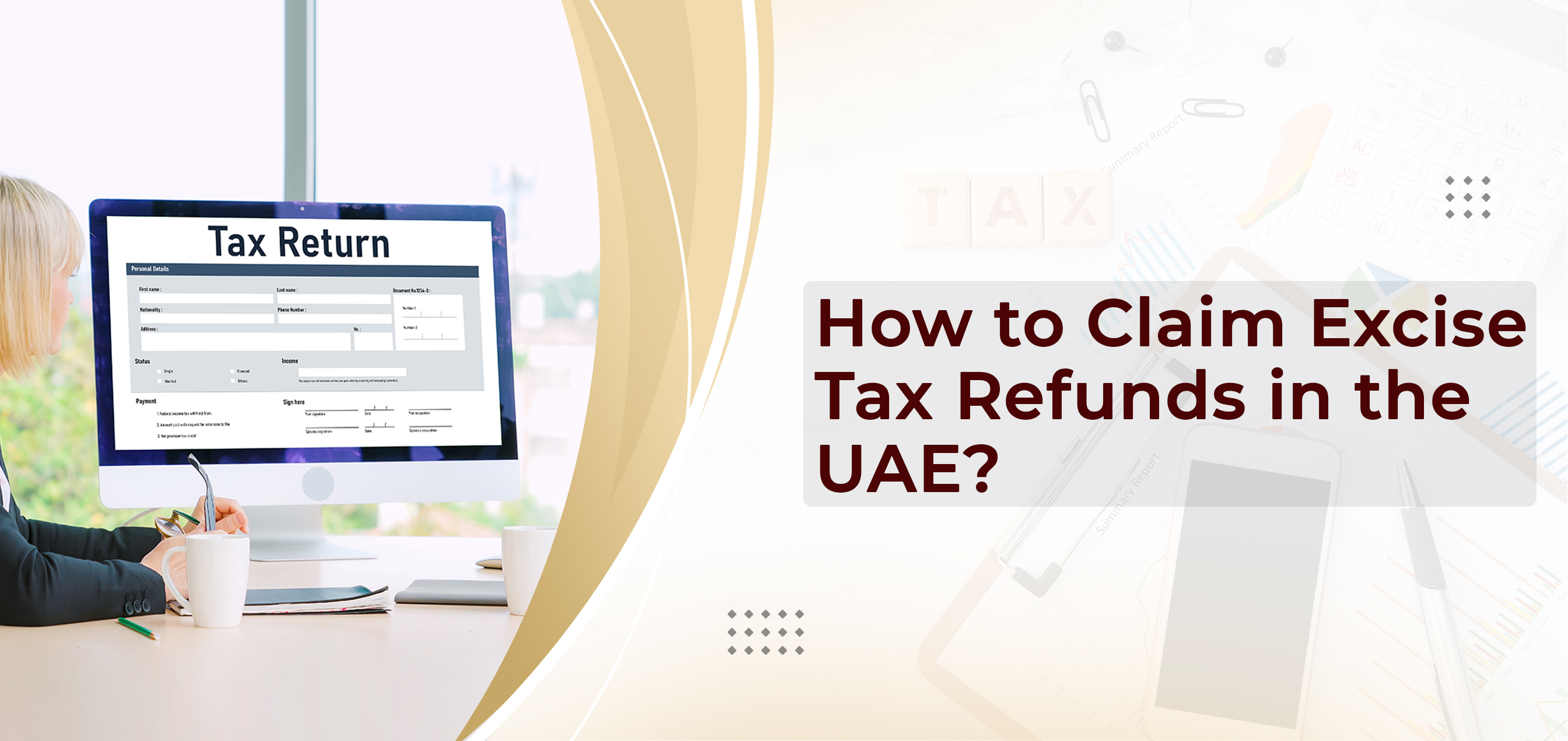
Claiming an excise tax refund Dubai involves multiple steps, all administered by the UAE Federal Tax Authority refund services
Here’s a simplified roadmap:
1. File Your Excise Tax Return
- Submit your periodic return using the FTA eServices portal.
2. Calculate Your Refundable Amount
- If the deductible tax exceeds the excise tax payable, you may have an excess refundable tax balance.
3. Prepare Supporting Documents
This could include:
-
Export documentation.
-
Evidence of incorporation of excise goods.
-
Proof of tax paid in error.
4. Submit an Online Refund Claim
-
Through the FTA portal, complete the Refund Application Form and attach supporting documentation.
5. FTA Review & Refund
-
If the FTA verifies your entitlement, the excess tax will be refunded or offset against future excise tax liabilities.
When Can Excise Tax Be Refunded in the UAE?
Excise tax refunds in the UAE are allowed in certain cases defined under Federal Decree-Law No. 7 of 2017 on Excise Tax and its Executive Regulations. The legal basis for excise tax refunds is primarily provided under Article 14 (Refund of Tax) of the Decree-Law.
Under Article 14, a taxpayer may claim a refund when excise tax has been paid in excess or becomes refundable due to specific qualifying circumstances.
Common situations where refunds may apply include:
-
Excess refundable tax: When deductible excise tax exceeds the tax payable in the tax return.
-
Export of excisable goods: If excise tax was paid in the UAE and the goods are later exported outside the country.
-
Overpayment or calculation errors: When excise tax is paid incorrectly or in excess.
-
Double taxation in production: When excise tax is paid on raw excisable materials and again on the final excisable product.
Businesses must submit refund requests through the Federal Tax Authority portal with supporting documentation for review and approval.
What Are the Legal Requirements for Excise Tax Refund Dubai?
Legal requirements for refunds are set out in the Executive Regulation of Federal Decree-Law No. 7 of 2017 on Excise Tax. The key provisions include:

These regulations aim to prevent double taxation and ensure fair treatment of exports and special cases.
What Documentation Is Needed for FTA Excise Tax Refund UAE?
When you apply for an excise tax refund in UAE, the FTA typically expects:
-
Completed online refund form.
-
Customs export declarations and shipping documents.
-
Proof of excise tax payment (returns & payment confirmations).
-
Commercial invoices.
-
Production evidence (manufacturing-based refund claims).
Important: Incomplete or insufficient documentation may lead the FTA to reject or defer the refund.
What Are Common UAE Excise Tax Penalty & Late Filing Fines?
Non-compliance with excise tax obligations can trigger:
-
Late filing fines.
-
Interest on late tax payments.
-
Administrative penalties under Tax Procedures Law.
-
Penalties may also be applied to other taxes such as UAE corporate tax penalties if compliance issues arise across filings.
It’s important to note that both excise tax and corporate tax share a common compliance framework under the Tax Procedures Law (Federal Decree-Law No. 28 of 2022), including amendments effective from January 2026.
Why Engage an FTA Approved Tax Agent UAE or Excise Tax Advisors?
Navigating the excise tax in UAE and refund claims can be complex. Many businesses choose to work with:
? FTA Approved Tax Agent UAE
Tax agents authorized by the FTA can:
-
Prepare and submit refund claims.
-
Represent taxpayers before the FTA.
-
Ensure compliance with statutory deadlines.
? Excise Tax Advisory UAE
Consultants offer expertise on:
-
Refund eligibility.
-
Documentation preparation.
-
Audit response and compliance planning.
? Excise Tax Consultants in Dubai
Local specialists who understand:
-
Dubai & UAE excise tax regulatory landscape.
-
FTA expectations and documentation nuances.
These professionals can help maximize your recovery and tax penalties UAE or late filing fines.
Conclusion
Claiming an FTA excise tax refund UAE is a structured process governed by federal laws and regulations. A clear understanding of eligibility, documentation, statutory limits, and FTA processes is critical. Leveraging expert guidance, whether an FTA approved tax agent UAE or excise tax advisors in UAE, can significantly improve refund outcomes and ensure compliance with evolving UAE tax frameworks.
Always refer to official FTA procedures and the relevant legislation when submitting refund claims. Seeking guidance from professional tax advisors like AMCA can simplify the process and improve refund outcomes. AMCA Auditing supports businesses with excise tax refund claims, documentation review, and compliance assistance, helping ensure that submissions align with regulatory requirements issued by the Federal Tax Authority.
Businesses should always refer to official FTA procedures and relevant legislation when submitting refund claims to remain compliant with the UAE’s evolving tax framework.
Frequently Asked Questions about Excise Tax Returns
1. What is excise tax and how does it differ from VAT?
Excise tax is a selective tax levied on specific goods considered harmful or luxury items, such as tobacco, energy drinks, and carbonated beverages. Unlike VAT, which is applied at 5% on most taxable supplies throughout the supply chain, excise tax is applied once at the point of production or import, making it a single-event tax on harmful goods.
2. Can non-registered businesses claim excise tax refunds?
Yes, under certain circumstances, non-registered businesses may claim excise tax refunds, especially if:
-
They are exporters of excisable goods to GCC implementing states
-
Goods are exported under customs supervision
-
Proper documentation, such as customs declarations and shipping certificates, is maintained.
These rules ensure businesses that handle excisable goods but are not fully registered can still recover refundable tax amounts.
3. What is the time limit for claiming excise tax refunds?
According to updated UAE Tax Procedures Law provisions effective January 2026, excise tax refund claims must generally be submitted within a five-year period from the date the tax was paid. Claims beyond this period may be rejected. Businesses must maintain supporting documentation for the full five years to ensure eligibility and compliance with FTA regulations.
4. Are refunds automatic once an excess refundable tax is available?
No. Refunds are not automatic, even if your account shows excess refundable tax. Businesses must:
-
Submit a formal refund request through the FTA portal
-
Attach supporting documentation proving payment and eligibility
-
Await approval from the Federal Tax Authority.
Only after FTA verification will the refund be processed, either as a payment or offset against future tax liabilities.
5. What documents prove export for a refund claim?
To support an excise tax refund claim, the FTA typically requires:
-
Customs export declarations showing goods leaving the UAE
-
Shipping or airway bills confirming transport to another jurisdiction
-
Commercial invoices or contracts as evidence of sale or transfer
Maintaining accurate and complete records is essential to validate export and satisfy the FTA’s documentation requirements.
6. Can excise tax refunds be paid in cash?
Refunds are generally processed through the FTA e-portal and may not be paid in cash. In most cases, the refundable amount is:
-
Credited directly to the business’s FTA account
-
Offset against future tax liabilities
-
Paid to the designated bank account only if requested and approved
This ensures secure, traceable, and compliant refund handling according to UAE regulations.
7. Does claiming an excise refund trigger an audit?
Not automatically. However, the FTA may review or audit refund claims to verify accuracy and compliance. Audits typically focus on:
-
Supporting documentation completeness
-
Eligibility of exported goods
-
Correct calculation of excise tax
Being prepared with organized records reduces risk and ensures a smooth refund process without unnecessary delays or penalties.
8. Can tourists claim excise tax refunds?
No. While VAT refunds for tourists are available under specific schemes, excise tax refunds are generally not included in tourist refund programs. Excise tax is a production/import-level tax, not a consumer-level consumption tax. Tourists cannot directly claim excise tax refunds when leaving the UAE, unlike VAT refunds on eligible goods purchased during their stay.
9. How do corporate tax penalties relate to excise tax?
Corporate tax and excise tax are both part of the UAE’s overall tax compliance framework. Noncompliance with excise tax rules can increase the FTA’s scrutiny of a business’s overall tax activities. Penalties for late payment, inaccurate filing, or incorrect claims in either domain can affect a company’s risk profile, potentially triggering audits, interest charges, or fines under related UAE tax laws.
10. Should I hire an excise tax consultant?
Yes. Engaging a professional excise tax consultant in Dubai helps businesses:
-
Correctly classify excisable goods
-
Prepare accurate refund claims
-
Ensure compliance with the FTA portal processes
-
Reduce audit risks and penalties
Consultants like AMCA Auditing provide expert guidance to streamline submissions, improve success rates, and maintain compliance with evolving UAE excise tax regulations.