
E-Invoicing Compliance & Advisory Service in UAE
- Home
- Services
- E-Invoicing Advisory
UAE E-Invoicing Compliance & Advisory Services
Businesses in the UAE are moving towards a fully digital invoicing environment under the UAE E-Invoicing Programme introduced by the Ministry of Finance (MoF). With mandatory implementation approaching, companies must ensure their invoicing systems, accounting processes, and tax records are ready for the transition.
AMCA Auditing provides E-Invoicing Advisory UAE services to help businesses understand UAE E-Invoice Regulations, assess their readiness, and implement compliant electronic invoicing solutions aligned with the UAE E-Invoicing Framework.
Our team supports businesses with e-invoicing readiness assessments, accounting system reviews, compliance gap analysis, implementation planning, and ongoing advisory to help ensure smooth adoption of the UAE E-Invoicing System.
Whether you are an SME or a large organisation, our E-Invoicing Consultant UAE services help you prepare for the transition while maintaining VAT Compliance UAE and meeting evolving UAE Tax Regulations.
What Is E-Invoicing in the UAE?
E-invoicing in the UAE refers to the electronic generation, exchange, and processing of invoices through a structured digital format that allows automated processing between businesses and approved platforms.
Unlike traditional invoices such as PDFs, scanned documents, or manually prepared invoices, UAE E-Invoicing requires invoices to be created and exchanged in a structured format through an approved electronic invoicing network.
The UAE E-Invoicing Programme is part of the UAE Government's wider digital transformation strategy aimed at improving:
- Tax compliance and transparency
- Invoice accuracy
- Business automation
- VAT reporting efficiency
- Digital transaction management
Under the MoF E-Invoicing Framework, businesses will need to ensure their invoicing processes are compatible with approved technical requirements, including the Peppol-based exchange model, and should get their business ready for e-invoicing in the UAE well ahead of the applicable deadlines.
How the UAE E-Invoicing System Works (Five-Corner Model)
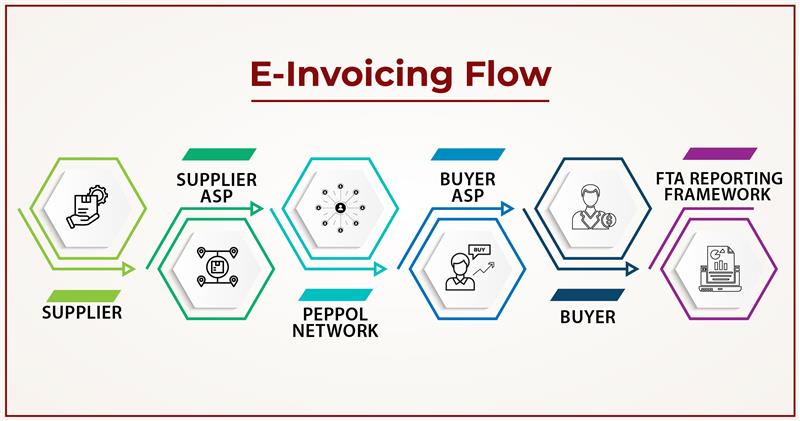
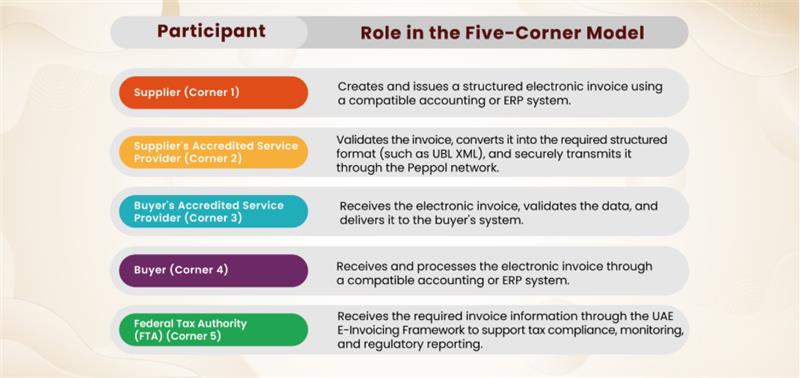
The UAE E-Invoicing Programme follows the Peppol Five-Corner Model, which enables the secure exchange of structured electronic invoices between businesses through Accredited Service Providers (ASPs).
Five-Corner Model
The UAE E-Invoicing System follows the Peppol Five-Corner Model, which enables the secure exchange of electronic invoices between buyers and suppliers through Accredited Service Providers (ASPs). Each participant has a specific role in ensuring invoices are exchanged securely, validated, and made available in accordance with the UAE E-Invoicing Framework.
Is E-Invoicing Mandatory in the UAE?
The UAE E-Invoicing Programme, introduced by the Ministry of Finance (MoF), will make electronic invoicing mandatory through a phased implementation approach. The initiative supports the UAE's digital tax transformation by replacing conventional invoicing methods with structured, machine-readable electronic invoices that enable automated invoice exchange, improve tax compliance, and enhance business efficiency.
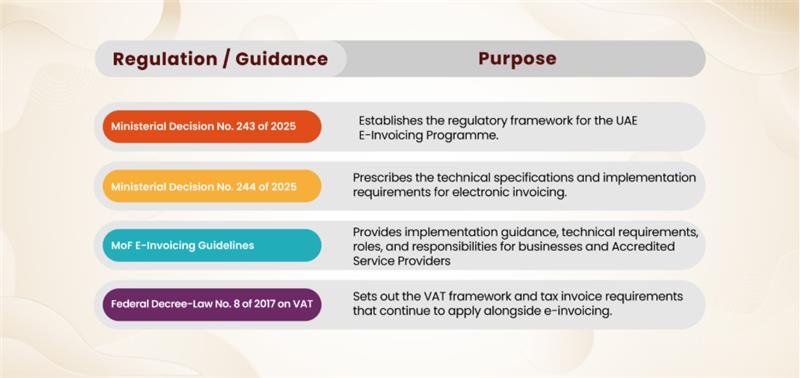
The implementation framework is supported by Ministerial Decision No. 243 of 2025 and Ministerial Decision No. 244 of 2025, together with the official MoF E-Invoicing Guidelines, which establish the technical framework, implementation requirements, and governance for the UAE E-Invoicing System.
Under the current framework, UAE E-Invoicing will generally apply to Business-to-Business (B2B) and Business-to-Government (B2G) transactions that fall within the scope of the programme. Certain transactions and business categories may be excluded based on the implementation framework and future guidance issued by the Ministry of Finance.
Businesses within the scope of the programme will be required to issue and exchange structured machine-readable electronic invoices through an Accredited Service Provider (ASP) approved under the UAE E-Invoicing Programme. In addition, businesses should review their accounting systems, invoicing processes, and internal controls to ensure compliance with the UAE E-Invoicing Framework, including requirements relating to invoice structure, data accuracy, secure system connectivity, and electronic document exchange.
The key implementation milestones include:
Pilot Phase – 1 July 2026
The UAE E-Invoicing Programme commenced with a pilot phase involving selected businesses and Accredited Service Providers (ASPs). The pilot enables participants to validate technical requirements, system integration, and operational processes before the wider rollout.
ASP Appointment Deadline for Large Businesses (Revenue ≥ AED 50 Million) – 30 October 2026
Following the Ministry of Finance announcement in May 2026, businesses with annual revenue exceeding AED 50 million are required to appoint an Accredited Service Provider (ASP) by 30 October 2026 to prepare for mandatory implementation.
Mandatory Go-Live for Large Businesses – 1 January 2027
Businesses meeting the prescribed revenue threshold will be required to commence compliant UAE E-Invoicing from 1 January 2027. Before this date, businesses should complete readiness assessments, system upgrades, ASP integration, and implementation planning.
ASP Appointment Deadline for Businesses (Revenue < AED 50 Million) – 31 March 2027
Businesses with annual revenue below AED 50 million must appoint an Accredited Service Provider by 31 March 2027, ahead of their mandatory go-live.
Expansion Phase – 1 July 2027
The UAE E-Invoicing requirements will gradually extend to additional businesses in accordance with the phased implementation roadmap issued by the Ministry of Finance. Organisations within future implementation phases should begin preparations early to facilitate a smooth transition.
ASP Appointment Deadline for Government Entities – 31 March 2027
Government entities are also required to appoint an Accredited Service Provider by 31 March 2027, in line with the same preparation timeline as smaller businesses.
Government Entities Phase (Mandatory Go-Live) – 1 October 2027
Government entities will transition to electronic invoicing as part of the final implementation phase, further supporting the UAE's digital economy and tax transformation initiatives.
Early preparation remains essential for successful implementation. Conducting an E-Invoicing Readiness Assessment UAE helps businesses identify technology gaps, evaluate ERP and accounting system compatibility, assess compliance with the MoF E-Invoicing Guidelines, and develop a practical implementation roadmap. AMCA Auditing supports businesses with E-Invoicing Advisory UAE, helping them understand regulatory requirements, prepare their systems, and achieve E-Invoicing Compliance UAE before the applicable implementation deadlines.
Key UAE E-Invoicing Regulations and Guidelines
AMCA Auditing supports businesses with E-Invoicing Advisory UAE, helping them understand regulatory requirements, prepare their systems, and achieve E-Invoice Compliance UAE before implementation deadlines.
Who Needs E-Invoicing in the UAE?
The UAE E-Invoicing System applies to businesses carrying out commercial activities in the UAE, including:
- Mainland companies
- Free zone companies
- VAT registered businesses
- Trading companies
- Professional service providers
- Manufacturing businesses
- Real estate companies
- Other businesses issuing commercial invoices
Companies should assess their obligations based on their business activities, revenue levels, and applicable UAE E-Invoice Regulations.
AMCA assists businesses in determining their requirements through an E-Invoicing Readiness Assessment UAE.
What Are the UAE E-Invoicing Requirements?
Businesses preparing for UAE E-Invoicing Compliance must ensure that their invoicing processes, accounting systems, and internal controls are ready to meet the requirements introduced under the UAE E-Invoicing Framework.
The transition from traditional invoicing methods to Electronic Invoicing UAE requires businesses to review their current processes, update their systems where necessary, and avoid common electronic invoice compliance mistakes so that invoices can be created, exchanged, and stored in a compliant digital format.
The key UAE E-Invoicing requirements include:
Structured Electronic Invoice Format
Under the UAE E-Invoicing Framework, structured electronic invoices are expected to use the UBL (Universal Business Language) XML format. This internationally recognized structured data format enables invoices to be generated, exchanged, and processed automatically between accounting systems, ERP platforms, and Accredited Service Providers (ASPs), reducing manual intervention and improving interoperability.
Unlike traditional invoices such as PDFs, scanned copies, or manually prepared documents, structured e-invoices contain organized data that can be automatically read and processed by accounting systems and approved platforms.
Businesses should ensure that their invoicing solutions can generate compliant electronic invoices containing the required transaction details while maintaining accuracy and consistency.
AMCA helps businesses review their existing invoice formats and assess whether their current processes are ready for UAE E-Invoicing implementation.
Accounting System Compatibility
A successful transition to UAE E-Invoicing depends heavily on whether existing accounting software or ERP systems can support electronic invoicing requirements.
Businesses should also assess whether their existing ERP or accounting software can support UAE E-Invoicing requirements. Common business systems such as SAP, Oracle, Microsoft Dynamics 365, Odoo, Zoho Books, and QuickBooks may require configuration, integration, or updates to align with the UAE E-Invoicing Framework and facilitate seamless connectivity with Accredited Service Providers.
Businesses should evaluate whether their current systems can handle:
- Electronic invoice generation
- Structured invoice data formats
- Automated data exchange
- System integration with approved platforms
- Digital invoice storage and record management
Companies using outdated accounting systems or manual invoicing processes may need to upgrade their technology infrastructure before implementation, including adopting AI and automation in accounting where relevant.
AMCA provides accounting system assessments and UAE E-Invoicing integration services to help businesses identify system gaps and prepare their financial processes for digital invoicing.
Accredited Service Provider Integration
Businesses implementing UAE E-Invoicing are required to connect with an Accredited Service Provider (ASP) approved under the UAE E-Invoicing Programme.
An ASP acts as an intermediary that facilitates the secure exchange of structured electronic invoices between businesses through the approved e-invoicing network.
Businesses should carefully evaluate ASP requirements, including:
- System compatibility
- Data transmission processes
- Security requirements
- Integration capabilities
- Compliance responsibilities
AMCA assists businesses in evaluating and selecting an appropriate Accredited Service Provider (ASP) based on their operational and technical requirements. We also provide implementation coordination by working with internal finance, IT, ERP, and implementation teams to support a smooth integration with the selected ASP and help businesses prepare for E-Invoice Compliance UAE.
Accurate Tax Information
Electronic invoices must continue to meet applicable UAE VAT Law and tax documentation requirements.
Businesses must ensure that invoice information remains accurate and complete, including:
- Tax Registration Number (TRN)
- Supplier and customer details
- Invoice date and unique invoice number
- Description of goods or services
- Taxable amount and VAT calculations
- Applicable tax rates
Maintaining accurate invoice data is essential for VAT Compliance UAE, tax reporting accuracy, and audit readiness.
AMCA helps businesses review their invoicing processes to ensure tax information is properly maintained and aligned with UAE Tax Regulations.
Data Security and Record Management
Businesses should also consider how electronic invoices will be securely stored, accessed, and maintained after implementation.
Proper record management helps businesses:
- Maintain complete transaction history
- Support tax audits and reviews
- Reduce document management risks
- Improve financial transparency
A well-planned e-invoicing system, supported by the right accounting and bookkeeping package, ensures that businesses can efficiently manage invoice data while meeting UAE digital tax compliance expectations.
Our E-Invoicing Advisory Services UAE
AMCA provides comprehensive E-Invoicing Services UAE designed to support businesses throughout their digital invoicing transition.
E-Invoicing Readiness Assessment UAE
We evaluate your current invoicing environment and identify areas requiring improvement.
Our assessment includes:
- Review of existing invoice processes
- Accounting software compatibility analysis
- Compliance gap identification
- Data readiness evaluation
- Implementation roadmap preparation
UAE E-Invoicing Compliance Advisory
Our experts help businesses understand their obligations under:
- UAE E-Invoicing Regulations
- MoF E-Invoicing Framework
- FTA Guidelines
- UAE VAT Law
- UAE Tax Regulations
We provide practical guidance to help businesses achieve E-Invoice Compliance UAE.
E-Invoicing Implementation UAE Support
Successful implementation requires coordination between tax, finance, and technology teams.
Our UAE e-invoicing implementation services include:
- Implementation planning
- Process evaluation
- Invoice workflow review
- System requirement assessment
- Compliance monitoring
Accounting System and ERP Review
Before implementing electronic invoicing, businesses must ensure their accounting infrastructure is prepared.
AMCA assists with:
- Accounting software assessment
- ERP compatibility review
- Invoice data mapping
- Integration requirement analysis
Our advisory helps businesses select suitable solutions based on their operational requirements.
Peppol UAE Implementation Advisory
The UAE E-Invoicing System follows the Peppol-based framework to enable secure exchange of electronic documents between businesses.
Our UAE Peppol implementation support helps businesses understand:
- Peppol requirements
- Network connectivity
- Data exchange processes
- Accredited Service Provider requirements
Accredited Service Provider (ASP) Advisory
An Accredited Service Provider plays an important role in UAE E-Invoicing implementation by enabling businesses to connect with the electronic invoicing network.
AMCA helps businesses understand:
- ASP requirements
- Selection considerations
- Integration expectations
- Compliance responsibilities
How Do Businesses Implement E-Invoicing in the UAE?
Implementing UAE E-Invoicing requires careful planning to ensure that accounting systems, invoice processes, and internal controls are aligned with the requirements of the UAE E-Invoicing Framework.
Businesses should follow a structured approach to prepare for successful e-invoicing implementation:
Step 1: Conduct an E-Invoicing Readiness Assessment
Businesses should begin by reviewing their current invoicing processes, accounting systems, and tax documentation procedures.
The assessment focuses on:
- Current invoicing processes
- Accounting system readiness
- Compliance gap identification
- Operational impact assessment
Step 2: Review System and Integration Requirements
Businesses should evaluate whether their existing accounting software or ERP systems are compatible with the UAE E-Invoicing System.
This includes reviewing:
- Invoice generation capabilities
- Data accuracy
- Integration requirements
- Electronic data exchange capabilities
Step 3: Select Suitable E-Invoicing Solutions
Businesses should evaluate suitable E-Invoicing Software UAE solutions and assess Accredited Service Providers (ASPs) based on their operational requirements.
The evaluation process includes:
- Software compatibility
- Accredited Service Provider (ASP) assessment
- Security and data protection features
- Scalability and future business requirements
Step 4: Configure and Test the System
Before going live, businesses should configure their systems and conduct testing to ensure invoices are generated correctly and comply with UAE E-Invoice Regulations.
The implementation phase includes:
- System configuration
- Invoice testing
- Data validation
- Process review
Step 5: Go-Live Support
Once testing is successfully completed, businesses should proceed with the go-live phase to transition from the testing environment to the production environment. Proper go-live support helps minimise operational disruptions, resolve implementation issues promptly, and ensure the e-invoicing solution functions as expected from the first day of deployment.
Go-live support includes:
- Production environment deployment
- System performance monitoring
- Issue identification and resolution
- Coordination with implementation teams
- Business continuity support
Step 6: Manage Change and User Adoption
Successful E-Invoicing Implementation UAE involves more than technology upgrades. Businesses should prepare their teams and internal processes to support the transition.
This includes:
- Employee training
- User adoption planning
- Internal process updates
- Finance and IT team coordination
Step 7: Assess Supplier and Customer Readiness
Electronic invoicing requires businesses to exchange invoices with trading partners through compatible systems. Reviewing supplier and customer readiness helps minimise disruptions during implementation.
The assessment includes:
- Supplier communication
- Customer communication
- Invoice exchange compatibility
- Master data validation
Step 8: Maintain Ongoing Compliance
After implementation, businesses should regularly review their e-invoicing processes to ensure continued compliance with updates issued by the Ministry of Finance (MoF), Federal Tax Authority (FTA), and other relevant authorities.
Ongoing compliance includes:
- Regulatory monitoring
- Process reviews
- Record management
- Compliance support
- Post-implementation monitoring
AMCA Auditing supports businesses throughout every stage of the UAE E-Invoicing implementation journey, from readiness assessment and compliance review to system evaluation and implementation planning.
Benefits of E-Invoicing Compliance Services UAE
Implementing UAE E-Invoicing helps businesses improve compliance, automate invoice processes, and prepare for the UAE's digital tax transformation.
Improved Tax Compliance
Helps businesses maintain accurate electronic invoice records and support compliance with UAE VAT Law and applicable tax requirements.
Reduced Manual Errors
Automated invoice generation and data exchange reduce mistakes caused by manual data entry, duplicate invoices, and incorrect information.
Faster Invoice Processing
Enables quicker invoice creation, approval, and exchange, improving workflow efficiency and reducing processing delays.
Better Audit Readiness
Structured electronic invoice records help businesses maintain organised documentation for audits, tax reviews, and compliance checks.
Improved Financial Visibility
Provides better access to invoice data, helping businesses monitor transactions, track payments, and make informed financial decisions.
Enhanced Operational Efficiency
Streamlines invoicing workflows by reducing administrative tasks and improving coordination between finance and operational teams.
Stronger Record Management
Supports secure digital storage of invoice records, making financial documents easier to access, manage, and maintain.
Future-Ready Business Operations
Helps businesses align with UAE digital transformation initiatives and prepare for future regulatory and technology changes.
Why Choose AMCA for E-Invoicing Advisory UAE?
AMCA Auditing combines tax expertise, accounting knowledge, and compliance experience to support businesses preparing for UAE E-Invoicing.
Our advantages include:
UAE Tax Compliance Expertise
We understand UAE VAT requirements, tax documentation standards,and regulatory obligations.
Practical Business-Focused Solutions
Our advisory focuses on your existing systems, processes, and operational needs.
SME-Friendly Advisory
We provide scalable solutions suitable for startups, SMEs, and growing businesses.
End-to-End Support
From readiness assessment to implementation planning, AMCA helps businesses prepare for digital invoicing compliance.
Industries We Support
Our E-Invoicing advisory services support businesses across various sectors, including:
- Trading companies
- Manufacturing businesses
- Construction companies
- Real estate businesses
- Professional service firms
- Healthcare organizations
- Hospitality businesses
- Free zone companies
Prepare Your Business for UAE E-Invoicing Compliance
The transition to electronic invoicing requires proper planning, system readiness, and regulatory understanding. AMCA Auditing helps businesses navigate UAE E-Invoicing requirements with practical advisory and compliance support.
Contact AMCA Auditing today for professional E-Invoicing Advisory Services UAE.
Frequently Asked Questions About UAE E-Invoicing
What is e-invoicing in the UAE?
E-invoicing in the UAE is a digital invoicing system that enables businesses to issue and exchange structured electronic invoices through approved channels.
When will e-invoicing become mandatory in the UAE?
UAE E-Invoicing will be implemented gradually through phases starting from July 2026, with mandatory requirements applying to businesses according to announced timelines.
Is e-invoicing mandatory for SMEs in UAE?
Yes, SMEs may fall within the UAE E-Invoicing requirements depending on applicable criteria and implementation phases.
What is Peppol UAE?
Peppol UAE refers to the electronic document exchange framework used to enable secure and standardized communication between businesses and approved service providers.
What is an Accredited Service Provider (ASP) in UAE e-invoicing?
An Accredited Service Provider is an approved entity that facilitates electronic invoice exchange between businesses through the UAE E-Invoicing System.
How much does e-invoicing implementation cost in the UAE?
The cost depends on factors such as business size, accounting system requirements, transaction volume, software integration needs, and selected service provider.
How can a business prepare for UAE e-invoicing?
Businesses should review their invoicing processes, assess accounting system readiness, understand UAE E-Invoice Regulations, and seek professional advisory support before implementation deadlines.