16 Oct 2026
Based on FTA Public Clarification TAXP010 and UAE tax legislation in force as of October 2026.
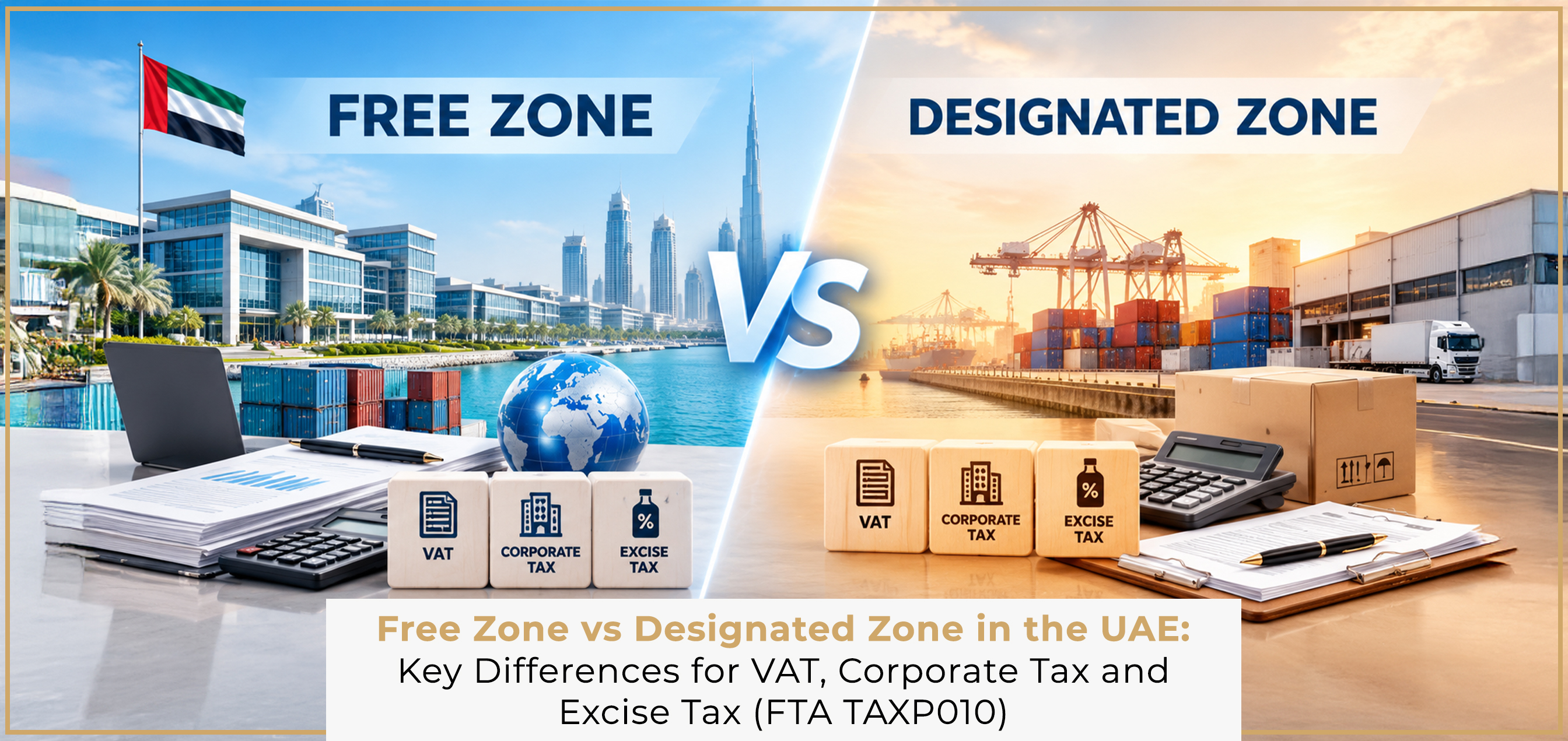
Under the Federal Tax Authority's (FTA) Public Clarification TAXP010, the definitions of a Free Zone and a Designated Zone differ for Corporate Tax, VAT and Excise Tax, and businesses must check their status under each tax law separately.
What Is FTA TAXP010?
FTA TAXP010 is the FTA's Public Clarification on Free Zones and Designated Zones for Tax Purposes, published in 2 October 2026.
-
It identifies four categories: Corporate Tax Free Zone, Corporate Tax Designated Zone, Excise Tax Designated Zone and VAT Designated Zone.
What Is a Free Zone for Corporate Tax Purposes?
Under Article 1 of Federal Decree-Law No. 47 of 2022 on the Taxation of Corporations and Businesses, as amended (the "Corporate Tax Law"), a Free Zone is "a designated and defined geographic area within the UAE that is specified in a decision issued by the Cabinet at the suggestion of the Minister."
According to FTA Public Clarification TAXP010, "A Free Zone offers Businesses various benefits such as relaxed foreign ownership restrictions, streamlined administrative procedures, modern and sophisticated infrastructure, developed Business communities and the availability of additional legal entity forms and commercial activities.".
All taxpayers should confirm with their respective Free Zone authority whether they are located in a Free Zone or Designated Zone for Corporate Tax purposes.
What Is a Designated Zone Under Each UAE Tax Law?
There is no single "Designated Zone" status for all UAE taxes. The treatment depends on the relevant Tax Law.
-
Corporate Tax: "A designated zone according to what is stated in the VAT Law, and which has been included as a Free Zone in accordance with the Corporate Tax Law" (Article 1, Cabinet Decision No. 100 of 2023).
-
VAT: "any area specified by a Cabinet Decision issued at the suggestion of the Minister, as a Designated Zone for the purpose of this Decree-Law" (Article 1, Federal Decree-Law No. 8 of 2017 on Value Added Tax, as amended, including by Federal Decree-Law No. 16 of 2025). These zones are listed in Cabinet Decision No. 59 of 2017, as amended.
-
Excise Tax: "any fenced area established as a free zone that cannot be entered or exited except through a designated road, or any area designated by the FTA as being subject to the supervision of a Warehouse Keeper" (Federal Decree-Law No. 7 of 2017 on Excise Tax, as amended).
What Is the Difference Between a Free Zone and a Designated Zone?


A VAT Designated Zone is not automatically a Designated Zone for Corporate Tax purposes. It must be recognised as both a VAT Designated Zone and a Free Zone for Corporate Tax purposes.
How Does Corporate Tax Apply in Designated Zones?
A Qualifying Free Zone Person (QFZP) is "a Free Zone Person that meets the conditions of Article 18 of the Corporate Tax Law and is subject to Corporate Tax under Article 3(2) of the Corporate Tax Law" (Article 1, Corporate Tax Law).
-
Article 3(2) of the Corporate Tax Law imposes Corporate Tax on a QFZP at "0% (zero percent) on Qualifying Income" and "9% (nine percent) on Taxable Income that is not Qualifying Income".
-
A QFZP may derive Qualifying Income from transactions with another Free Zone Person that is the Beneficial Recipient of the transaction and does not relate to an Excluded Activity, or from a Qualifying Activity that is not an Excluded Activity. These are two categories of Qualifying Income set out in Article 3(1) of Cabinet Decision No. 100 of 2023, so they are not the only ones. Under Article 3(3) of the same Decision, "Beneficial Recipient" shall mean "a Person who has the right to use and enjoy the service or the Good and does not have a contractual or legal obligation to supply such service or Good to another person."
-
Under Article 2(1)(l) of Ministerial Decision No. 229 of 2025, "distribution of goods or materials in or from a Designated Zone conducted by a Qualifying Free Zone Person shall be considered a Qualifying Activity."
-
Under Article 2(3)(l) of Ministerial Decision No. 229 of 2025, "distribution of goods or materials in or from a Designated Zone, includes the buying and selling of goods, materials, component parts or any other items that are tangible or movable and may include the importation, storage, inventory management, handling, transportation and exportation of such goods or materials or parts thereof, provided that such activities are conducted in or from a Designated Zone, and the goods or materials entering the State are imported through the Designated Zone, and the goods or materials are supplied to any of the following:
-
A customer who resells, processes or alters such goods or materials, or parts thereof for the purposes of sale or resale.
-
A public benefit entity."
-
-
Under Article 2(3) of Ministerial Decision No. 84 of 2025, without prejudice to Clause 1 of that Article, a Qualifying Free Zone Person engaged in the distribution of goods or materials in or from a Designated Zone, in accordance with Ministerial Decision No. 265 of 2023, must comply with any additional procedures prescribed by the FTA. These additional procedures are set out in FTA Decision No. 6 of 2026, which requires an Agreed-Upon Procedures (AUP) report.
-
Under Article 5(2) of Ministerial Decision No. 229 of 2025, "a Qualifying Free Zone Person that at any particular time during a Tax Period fails to meet any of the conditions set out in Article 18(1) of the Corporate Tax Law and the Decision and any other conditions prescribed by the Minister shall cease to be a Qualifying Free Zone Person from the beginning of the relevant Tax Period and for the subsequent four Tax Periods."
How Does VAT Apply in Designated Zones?
Under Article 51(1) of the VAT Executive Regulation (Cabinet Decision No. 52 of 2017, as amended), a Designated Zone "shall be treated as being outside the State and outside the Implementing States", subject to the following conditions:
-
"The Designated Zone is a specific fenced geographic area and has security measures and Customs controls in place to monitor entry and exit of individuals and movement of goods to and from the area."
-
"The Designated Zone shall have internal procedures regarding the method of keeping, storing and processing of Goods therein."
-
"The operator of the Designated Zone complies with the procedures set by the Authority."
A VAT Designated Zone is not outside the scope of VAT for every transaction. Under Article 51 of the VAT Executive Regulation (Cabinet Decision No. 52 of 2017, as amended), "Where a supply of Goods is made within a Designated Zone to a Person to be consumed by him or another person, then the place of supply of these Goods shall be in the State", except in the cases set out in that Article. Article 51 also provides that "The Place of supply of water or any form of energy shall be considered to be inside the State if the place of supply is in a Designated Zone.
Speak to our VAT consultants today.
How Does Excise Tax Apply in Designated Zones?
Under Article 15(2) of the Excise Tax Executive Regulation (Cabinet Decision No. 37 of 2017, as amended), a fenced free zone qualifies where it "has security measures in place to restrict entry and exit of individuals and movement of Excise Goods", "is controlled and supervised by a customs department" and has an appointed Warehouse Keeper.
For any other area to be specified by the FTA, the following conditions must be met: "The area is a specified geographic area", security measures are in place to restrict entry and exit, and "A Warehouse Keeper must be appointed for the area." The Warehouse Keeper must submit an application to the FTA to register the area as a Designated Zone.
A Warehouse Keeper is "any Person approved and registered at the Authority to supervise a Designated Zone" (Article 1, Excise Tax Law). Learn more about our Excise Tax services.
How Can AMCA Help?
AMCA is an FTA-registered tax agency. Our specialists can confirm your Designated Zone status under each tax law and review QFZP eligibility through our Corporate Tax services.
+971 4 240 8784 | ? info@amcaauditing.com | www.amcaauditing.com
What Are the Most Frequently Asked Questions About Designated Zones UAE?
Is every Free Zone in the UAE a Designated Zone?
No, and the answer can differ for each tax.
-
A Free Zone is specified by Cabinet Decision for Corporate Tax purposes.
-
Designated Zone status depends on meeting the conditions of each tax law.
-
Many Free Zones do not appear on the VAT list of Designated Zones.
Who confirms whether a business is located in a Designated Zone?
TAXP010 names a different point of contact for each tax.
-
Corporate Tax: the relevant Free Zone authority.
-
Excise Tax: the Free Zone authority or the Warehouse Keeper.
-
VAT: the FTA's published list, plus confirmation from the Free Zone authority that the Article 51(1) conditions are met.
What documents support the AUP report for Designated Zone distributors?
Distributors should keep evidence that supports both reseller status and Designated Zone importation.
-
Import declarations and customs clearance documents
-
Shipping documents such as bills of lading or airway bills
-
Inventory, warehousing and goods movement records
-
Customer documentation supporting reseller status
Does FTA TAXP010 change UAE tax law?
No. TAXP010 states the FTA's position on how existing legislation applies and expressly does not amend any law. It is effective from the date the relevant legislation came into force, unless stated otherwise, so businesses should read it alongside the laws and decisions it clarifies.
Are services supplied within a VAT Designated Zone outside the scope of VAT?
Generally, no. The outside-the-UAE treatment under Article 51 of the VAT Executive Regulation is directed at goods. Services supplied within a VAT Designated Zone are generally treated as supplied in the UAE and follow the normal VAT rules, so businesses should not assume that operating from a Designated Zone removes VAT on services.
Disclaimer: This article is for general information only and does not constitute tax or legal advice. It is based on FTA Public Clarification TAXP010 and the UAE tax legislation cited above, as amended, as at the last updated date.