16 Nov 2026
Many businesses focus on submitting their corporate tax return UAE on time. However, timely filing alone does not guarantee compliance. Errors in tax calculations, incomplete records, incorrect disclosures and missing documentation can result in corporate tax penalties UAE, additional scrutiny from the Federal Tax Authority UAE (FTA) and unnecessary compliance issues, even after a return has been submitted.
Under Federal Decree-Law No. 47 of 2022 on the Taxation of Corporations and Businesses and its amendments, taxable persons are required to determine and report their taxable income accurately. In addition, Federal Decree-Law No. 28 of 2022 on Tax Procedures, as amended by Federal Decree-Law No. 17 of 2025 (effective 1 January 2026), establishes the procedural obligations for registration, record keeping, filing, corrections and tax administration. For a broader view of your obligations this year, see our guide on how to stay fully compliant with UAE tax laws in 2026.
This guide explains the most common Corporate Tax Mistakes UAE businesses should avoid. It also covers how to correct errors in a return that has already been filed, what to do if a deadline has been missed, and how to prepare accurately for your next filing.
What Are Common Corporate Tax Mistakes?
Understanding the most frequent mistakes helps businesses review returns they have already filed. It also helps them strengthen their corporate tax compliance UAE for future filings.
Many businesses assume that Corporate Tax compliance is limited to submitting a return. In reality, compliance begins much earlier with proper accounting, documentation and tax planning.
Some of the most common corporate tax errors UAE include:
-
Failing to complete corporate tax registration UAE within the prescribed timelines.
-
Maintaining incomplete or inaccurate accounting records UAE.
-
Using incorrect figures from the financial statements UAE.
-
Incorrectly classifying taxable and exempt income. This is especially common for businesses that misunderstand the differences between free zones and designated zones.
-
Ignoring related party disclosures and transfer pricing UAE requirements.
-
Failing to reconcile accounting records before tax filing UAE.
-
Not retaining sufficient supporting documentation for deductions.
-
Depending on estimates instead of verified accounting data.
These mistakes often increase the likelihood of additional reviews by the Federal Tax Authority UAE. They may also lead to administrative penalties under the relevant Cabinet Decisions on administrative penalties, including Cabinet Decision No. 75 of 2023, as amended, for Corporate Tax violations. Businesses should therefore establish strong internal controls before preparing their corporate tax return UAE.
What Errors Delay Corporate Tax Filing?
Several avoidable mistakes can delay the submission of your Corporate Tax Return.
Businesses frequently postpone tax preparation until the filing deadline approaches. This creates unnecessary pressure and increases the possibility of filing inaccurate information.
Common corporate tax filing mistakes UAE include:
-
Delayed preparation of audited or final financial statements UAE.
-
Incomplete reconciliation between accounting records and tax computations.
-
Missing supporting invoices and expense documentation.
-
Failure to identify related party transactions requiring transfer pricing UAE documentation.
-
Incorrect adjustments when calculating taxable income.
-
Lack of coordination between finance, accounting and tax teams.
-
Poor quality bookkeeping due to delayed accounting updates.
Accurate bookkeeping services UAE play a significant role in ensuring financial information is complete before Corporate Tax calculations begin. Keeping records updated throughout the year, supported by regular monthly financial reviews, reduces last-minute corrections and filing delays.
Under Federal Decree-Law No. 28 of 2022 on Tax Procedures, as amended, taxpayers are required to maintain the records and documents necessary for tax administration and compliance. Proper documentation enables businesses to substantiate the information reported in their tax returns.
What Happens If Corporate Tax Returns Are Incorrect?
Submitting an inaccurate Corporate Tax Return can result in compliance issues, additional reviews and administrative penalties, even if the return was filed on time.
Errors in a corporate tax return UAE do not always arise from intentional non-compliance. In many cases, businesses make mistakes due to incorrect tax adjustments, incomplete documentation or misunderstanding the provisions of the corporate tax law UAE. Nevertheless, businesses remain responsible for ensuring the accuracy of the information submitted to the Federal Tax Authority UAE.
Common consequences of incorrect tax returns include:
-
Administrative corporate tax penalties UAE where applicable under the relevant administrative penalty rules.
-
Requests from the FTA corporate tax UAE team for additional documents or clarifications.
-
Delays in processing amendments or tax assessments.
-
Increased likelihood of a tax audit or compliance review.
-
Additional time and costs required to correct errors and resubmit information.
Found an error in a filed return? Once the filing deadline has passed, errors in a submitted return are generally corrected through a voluntary disclosure on EmaraTax rather than a simple amendment. Correcting an error before the FTA identifies it is usually treated more favourably than waiting for an audit. If a return was prepared under time pressure, a post-filing review is therefore worthwhile.
A revised administrative penalty framework introduced by Cabinet Decision No. 129 of 2025 took effect on 14 April 2026, changing how certain tax penalties are calculated. Businesses should confirm which penalty rules apply to their specific situation.
How Can Businesses Avoid Tax Penalties?
A proactive compliance approach significantly reduces the risk of Corporate Tax errors and penalties.
Businesses should not wait until the filing deadline approaches to review their tax position. Early preparation provides sufficient time to identify errors, obtain missing documentation and complete the required tax computations accurately.
To strengthen corporate tax compliance UAE, businesses should:
-
Review whether corporate tax registration UAE has been completed correctly.
-
Reconcile accounting records with the final financial statements UAE before preparing the tax computation.
-
Verify that taxable income adjustments comply with the corporate tax law UAE.
-
Review all related party transactions and prepare transfer pricing UAE documentation where required.
-
Ensure deductible expenses are properly supported with relevant documentation.
-
Maintain complete accounting records UAE in accordance with statutory record-keeping requirements.
-
Review previous tax calculations for inconsistencies before filing.
-
Correct known errors in past returns through voluntary disclosure rather than waiting for an FTA review.
-
Seek professional advice from experienced Corporate Tax consultants in the UAE where complex tax adjustments or exemptions apply.
Establishing a structured review process before filing helps businesses minimise corporate tax errors UAE, improve reporting accuracy and reduce the likelihood of regulatory issues with the Federal Tax Authority UAE.
How Can Businesses Prepare for Their Corporate Tax Filing Deadline?

Preparing early enables businesses to complete their Corporate Tax obligations accurately and confidently.
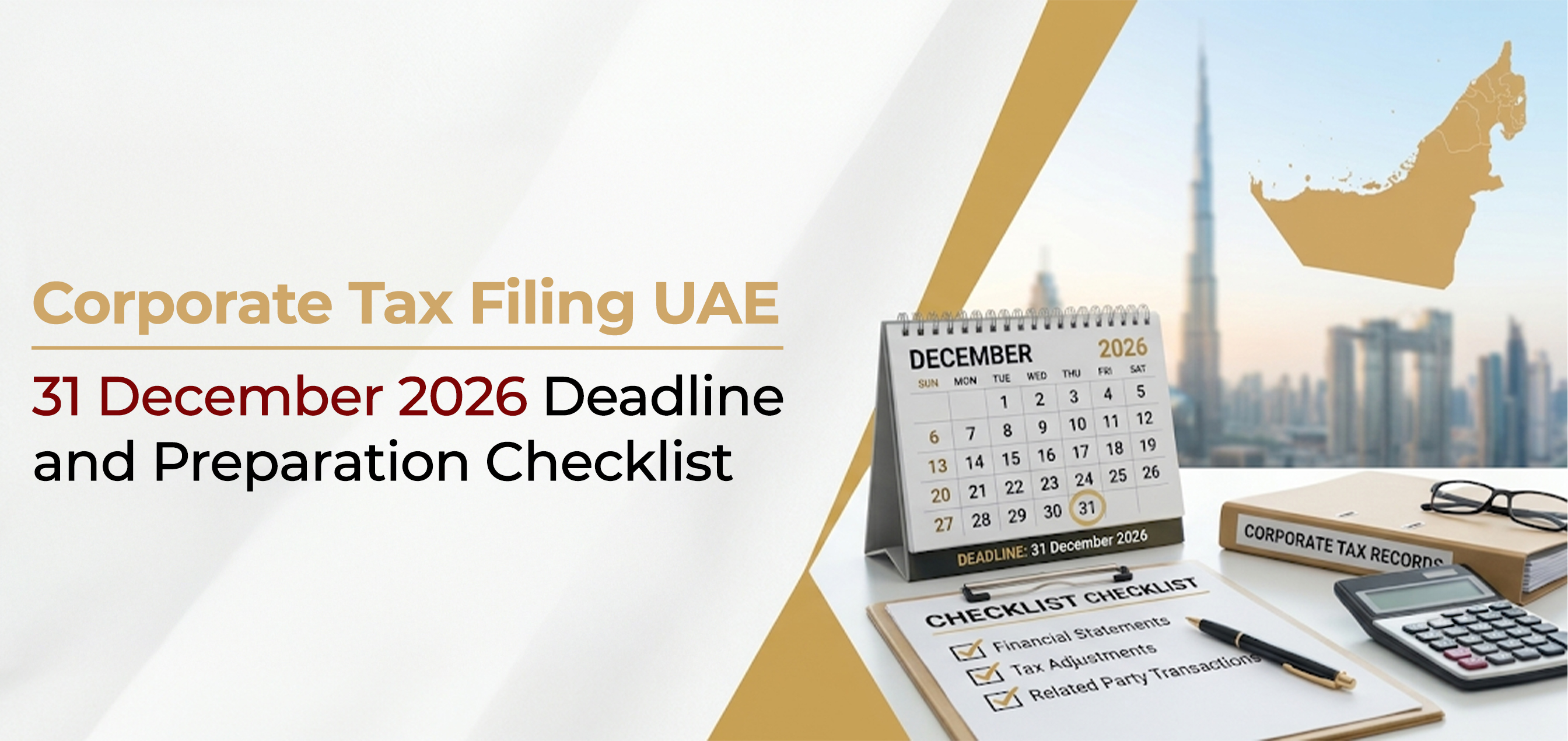
Under Article 53 of Federal Decree-Law No. 47 of 2022, as amended, taxable persons are required to file a Corporate Tax Return in the prescribed form within nine months from the end of the relevant Tax Period. Any Corporate Tax due must be paid within the same period. This obligation applies to every taxable person, and companies with no profit still need to file a Corporate Tax return. Each business should calculate its own deadline based on its financial year-end and plan its preparation well ahead of that date.
A practical pre-filing checklist includes:
-
Confirm that Corporate Tax registration details are accurate and up to date.
-
Keep bookkeeping current and reconcile it monthly.
-
Finalise the year’s financial statements UAE promptly after year-end.
-
Reconcile bookkeeping records with accounting ledgers.
-
Verify taxable income calculations and tax adjustments.
-
Review exemptions, elections and reliefs before finalising the return.
-
Assess whether transfer pricing UAE documentation is required.
-
Check that all supporting records are complete and readily available.
-
Conduct an internal compliance review before submitting the corporate tax return UAE.
-
File the return within the prescribed timeline through the EmaraTax platform.
Missed your filing deadline? File the outstanding return and pay any tax due through EmaraTax as soon as possible. Late filing and late payment penalties continue to build for as long as the return or payment remains outstanding. Keep a record of the reasons for the delay, as these may be relevant if you later request a penalty waiver or reconsideration.
Preparing in advance not only supports tax compliance UAE but also helps businesses avoid unnecessary corrections, delays and potential corporate tax penalties UAE.
Conclusion
Avoiding common Corporate Tax mistakes starts with proper planning, accurate financial records and a clear understanding of UAE tax obligations. The following steps help your business strengthen corporate tax compliance UAE and reduce the risk of filing errors:
-
preparing well ahead of your filing deadline
-
verifying your tax calculations
-
maintaining complete supporting documentation
-
correcting any errors in filed returns promptly through voluntary disclosure
How Can AMCA Help You?
AMCA Auditing & Business Advisors assists businesses in meeting their UAE Corporate Tax obligations with confidence and accuracy.
We can help you with:
-
Corporate Tax registration and deregistration.
-
Corporate Tax return preparation and filing.
-
Tax computation and taxable income review.
-
Financial statement reconciliation.
-
Transfer Pricing documentation and compliance.
-
Review of accounting records and bookkeeping.
-
Pre-filing and post-filing Corporate Tax health checks.
-
Voluntary disclosures to correct errors in filed returns.
-
Late filing support and penalty reconsideration requests.
-
Representation before the Federal Tax Authority (FTA).
With AMCA’s experienced tax professionals, your business can focus on growth while ensuring full compliance with the UAE Corporate Tax framework. Contact us today to book a Corporate Tax health check.
Frequently Asked Questions (FAQs)
1. What are common Corporate Tax mistakes?
Businesses can reduce the risk of errors by avoiding the following common mistakes:
-
Failing to complete corporate tax registration UAE within the required timeline.
-
Maintaining incomplete or inaccurate accounting records UAE.
-
Preparing the corporate tax return UAE using unreconciled financial data.
-
Incorrectly calculating taxable income or tax adjustments.
-
Overlooking transfer pricing UAE requirements for related party transactions.
-
Filing the return without reviewing supporting documentation.
2. How can businesses avoid tax penalties?
The following best practices help businesses strengthen their Corporate Tax compliance and minimise the risk of penalties:
-
Maintain accurate and up-to-date bookkeeping throughout the year.
-
Prepare final financial statements UAE before calculating taxable income.
-
Keep supporting invoices, contracts and accounting records.
-
Review tax computations before submission.
-
File and pay within the prescribed deadline.
-
Correct known errors promptly through voluntary disclosure.
-
Seek professional advice where complex tax matters arise.
3. What errors delay Corporate Tax filing?
The following issues commonly delay the Corporate Tax filing process:
-
Incomplete bookkeeping records.
-
Delayed preparation of financial statements.
-
Missing supporting documents.
-
Incorrect reconciliation of accounting records.
-
Unresolved related party transactions requiring transfer pricing UAE documentation.
-
Last-minute corrections before submission.
4. What happens if Corporate Tax returns are incorrect?
Submitting an incorrect corporate tax return UAE may result in requests from the Federal Tax Authority UAE for additional information, amendments or clarification. Depending on the nature of the error and the applicable administrative penalty rules, businesses may also face administrative corporate tax penalties UAE. If an error is found after the filing deadline, it should generally be corrected through a voluntary disclosure on EmaraTax.
5. How can businesses prepare for their Corporate Tax filing deadline?
Businesses should first calculate their deadline, which is nine months from the end of their tax period. They should then begin preparing well in advance:
-
Review their accounting records.
-
Reconcile their financial statements.
-
Verify taxable income calculations.
-
Ensure all required documentation is available.
-
Assess whether any elections, reliefs, exemptions or transfer pricing UAE obligations apply before filing.
Early preparation improves corporate tax compliance UAE and allows enough time to resolve issues before the return is due.