01 Oct 2026
This article is intended for general informational purposes and does not constitute tax or legal advice. Corporate Tax positions are fact-specific; businesses should confirm their QFZP status and filing obligations with a qualified UAE tax advisor or directly with the Federal Tax Authority before acting on the guidance below.
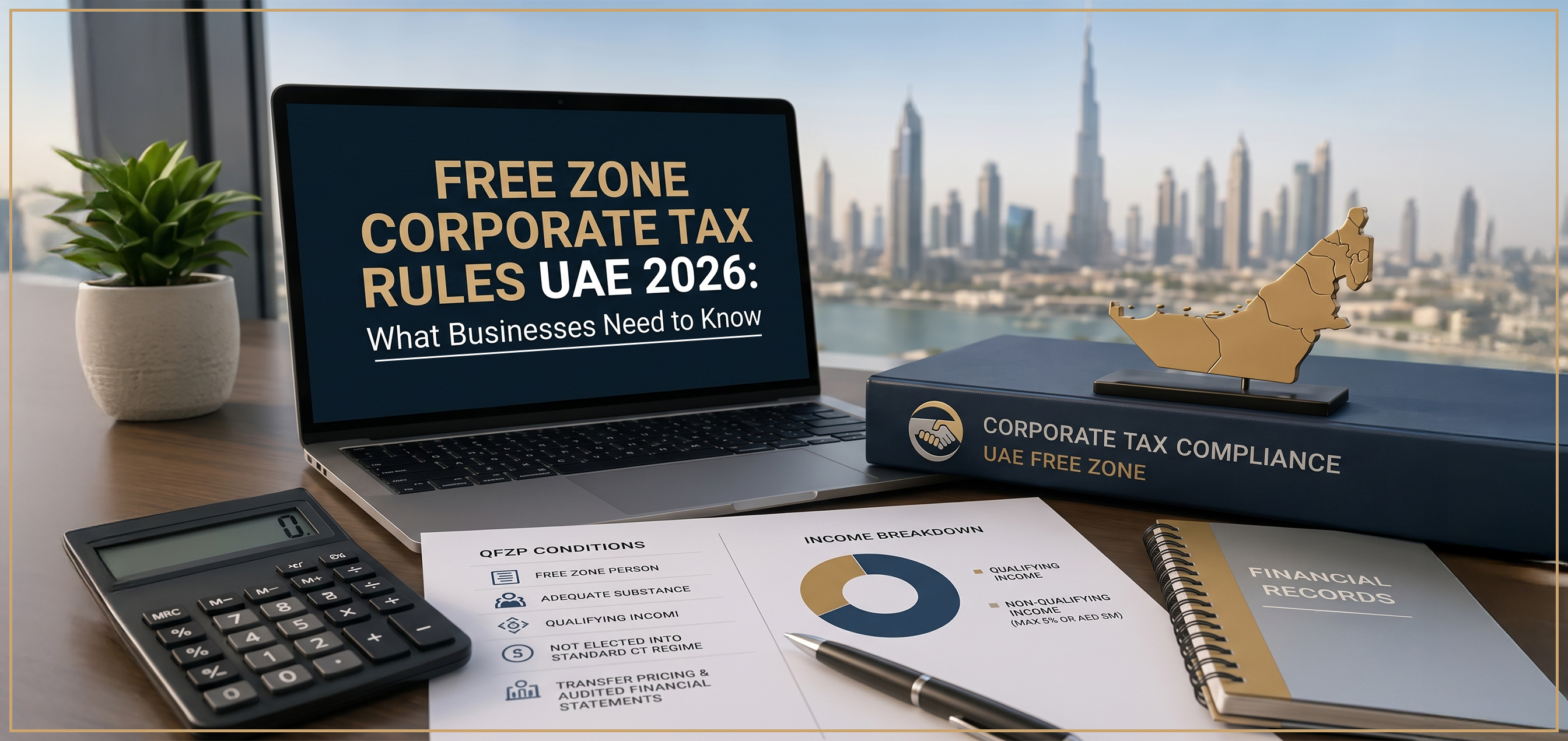
The UAE continues to strengthen its tax framework while maintaining the attractiveness of its Free Zones for investors and entrepreneurs. The Free Zone Corporate Tax Rules UAE 2026 provide eligible businesses with significant tax benefits, but only if they comply with the conditions prescribed under the Corporate Tax Law and related regulations. Businesses operating in Free Zones must understand the distinction between qualifying and non-qualifying income, registration requirements, filing obligations, and compliance standards to retain their preferential tax treatment.
This guide explains the latest free zone corporate tax UAE rules applicable in 2026, the conditions for becoming a Qualifying Free Zone Person (QFZP UAE), and the compliance obligations businesses should follow.
A note from practice: In our advisory work, the most common QFZP status loss we see isn't caused by a business knowingly engaging in an excluded activity — it's caused by revenue mix drifting over the course of the year until the de minimis threshold (the lower of AED 5 million or 5% of total revenue) is breached without anyone noticing until year-end reconciliation. Reviewing the qualifying/non-qualifying revenue split quarterly, not just annually, is the single change that prevents this most reliably.
What Are Free Zone Corporate Tax Rules in UAE?
The Free Zone Corporate Tax Rules in the UAE establish the conditions under which eligible Free Zone entities can benefit from a 0% Corporate Tax on qualifying income while remaining subject to the 9% Corporate Tax rate on taxable income that does not qualify.
Under the applicable framework:
-
Free Zone entities are subject to Federal Decree-Law No. 47 of 2022, as amended by Federal Decree-Law No. 60 of 2023, on the Taxation of Corporations and Businesses.
-
Eligible businesses may qualify as a Qualifying Free Zone Person (QFZP), provided they satisfy the prescribed conditions.
-
A 0% Corporate Tax rate applies only to qualifying income, as determined under the applicable legislation.
-
Non-qualifying income is generally subject to the standard 9% Corporate Tax rate.
-
QFZPs must maintain adequate economic substance, satisfy the de minimis requirements, prepare audited financial statements where required, and comply with all other conditions to retain the 0% Corporate Tax benefit.
-
Corporate Tax registration and the annual filing of Corporate Tax returns remain mandatory, even where the applicable Corporate Tax rate is 0%.
-
Ministerial Decision No. 229 of 2025 expands and clarifies the scope of qualifying and excluded activities for QFZPs and replaces the earlier Ministerial Decision No. 265 of 2023, with effect from 1 June 2023.
Who Qualifies as a Qualifying Free Zone Person?
A business must satisfy specific legal conditions to be treated as a qualifying free zone person UAE.
To qualify as a QFZP UAE, the business should:
-
Be incorporated or established in a recognized UAE Free Zone.
-
Maintain adequate economic substance within the Free Zone.
-
Earn qualifying income as prescribed under Cabinet Decision No. 100 of 2023.
-
Meet the de minimis requirements relating to non-qualifying revenue.
-
Prepare audited financial statements
-
Comply with transfer pricing UAE requirements.
-
Maintain proper accounting records.
-
Continue to satisfy all eligibility requirements throughout each tax period.
Failure to meet these conditions may result in the loss of the preferential tax treatment under the Corporate Tax regime.
Are Free Zone Companies Exempt from Corporate Tax?
Many businesses assume every Free Zone entity automatically enjoys a free zone tax exemption UAE, but this is incorrect.
The Corporate Tax treatment depends on whether the entity qualifies as a QFZP.
Key points include:
-
The exemption is not automatic.
-
Only qualifying income benefits from the 0% Corporate Tax rate.
-
Non-qualifying taxable income is generally subject to Corporate Tax.
-
Businesses that fail QFZP conditions may lose the preferential regime.
-
Continuous compliance is necessary to preserve the tax benefit.
Businesses should therefore regularly review their activities, income sources, and operational structure to ensure continued eligibility.
What Is Qualifying Income Under UAE Corporate Tax?
Understanding qualifying income UAE is essential for every Free Zone business, because only this income benefits from the 0% Corporate Tax rate.
Cabinet Decision No. 100 of 2023 specifies the categories of income that may qualify for the 0% Corporate Tax rate. Generally, qualifying income may include:
-
Income from transactions with other Free Zone Persons, except income from Excluded Activities.
-
Income from transactions with Non-Free Zone Persons, but only where it is derived from Qualifying Activities that are not Excluded Activities.
-
Qualifying intellectual property income, as calculated under the prescribed rules.
-
Other income, provided the de minimis requirements are met.
In addition to earning qualifying income, a business must also satisfy the separate conditions for QFZP status, such as the de minimis requirement, adequate economic substance in the Free Zone, and, for large multinational groups, applicable Pillar Two and Domestic Minimum Top-up Tax (DMTT) obligations. These conditions are explained in the section "Who Qualifies as a Qualifying Free Zone Person?" above.
Businesses should also identify activities classified as Excluded Activities, as income from those activities may become taxable. Proper classification of income is therefore a critical aspect of free zone tax compliance UAE.
A note from practice: One area we're regularly asked about since MD 229 took effect: the expanded qualifying-commodities list (which now covers industrial chemicals, by-products, and environmental commodities such as carbon credits) applies retroactively to 1 June 2023. Businesses that filed earlier Corporate Tax returns under the older, narrower MD 265 definitions should check whether those filings should be revisited in light of the wider scope.
Do Free Zone Companies Need to File Corporate Tax Returns?
Yes. Even businesses benefiting from the 0% Corporate Tax rate must comply with corporate tax filing UAE obligations.
Compliance requirements include:
-
Complete corporate tax registration UAE with the Federal Tax Authority.
-
Maintain proper accounting records.
-
Prepare financial statements.
-
File Corporate Tax returns within the prescribed deadlines.
-
Retain supporting documentation.
-
Maintain transfer pricing documentation where applicable.
Receiving a 0% Corporate Tax rate does not remove the obligation to comply with filing and reporting requirements.
How Does Free Zone Tax Compliance UAE Help Businesses Maintain QFZP Status?
Maintaining free zone tax compliance UAE is essential for preserving the benefits available under the Corporate Tax regime.
Businesses should:
-
Monitor qualifying and non-qualifying income regularly.
-
Maintain complete accounting records.
-
Conduct periodic internal compliance reviews.
-
Prepare audited financial statements where required.
-
Monitor transfer pricing arrangements.
-
Review related-party transactions carefully.
-
Ensure timely filing with the FTA.
-
Stay updated with evolving UAE tax regulations.
Strong compliance practices reduce regulatory risks and support long-term business continuity.
Why Is Transfer Pricing UAE Important for Free Zone Businesses?
Transfer pricing rules apply to Free Zone businesses engaging in related-party or connected person transactions.
Businesses should ensure:
-
Transactions are conducted at arm's length.
-
Supporting documentation is maintained.
-
Pricing methodologies are properly documented.
-
Related-party and connected party agreements are retained.
-
Financial records support reported values.
-
Annual Corporate Tax filings accurately reflect these transactions.
Compliance with transfer pricing rules is an important condition for maintaining QFZP eligibility under the Corporate Tax framework.
How Can Businesses Stay Updated with UAE Tax Regulations in 2026?
Corporate Tax guidance continues to evolve as the UAE refines its tax framework.
Businesses should:
-
Monitor updates issued by the Federal Tax Authority.
-
Review Ministry of Finance announcements.
-
Stay informed about amendments affecting Free Zone taxation.
-
Conduct periodic tax health checks.
-
Obtain professional advice before restructuring business activities.
-
Review annual Corporate Tax obligations before filing.
Remaining informed helps businesses adapt to changing regulatory expectations while protecting available tax benefits.
How Can AMCA Help Your Free Zone Business?
Navigating UAE Corporate Tax regulations requires careful planning and continuous compliance. Our tax advisory team has supported Free Zone businesses through registration, QFZP eligibility assessments, and return filing since the Corporate Tax regime's introduction in June 2023, including through the transition from MD 265 to MD 229.
AMCA can help you by:
-
Assessing your QFZP UAE eligibility.
-
Assisting with corporate tax registration UAE.
-
Preparing Corporate Tax returns.
-
Reviewing qualifying and taxable income.
-
Supporting transfer pricing documentation.
-
Conducting Corporate Tax compliance reviews.
-
Helping your business remain compliant with the latest UAE tax regulations.
Navigating UAE Corporate Tax regulations requires careful planning and continuous compliance. As an FTA approved Tax Agency, AMCA's tax advisory team has supported Free Zone businesses through registration, QFZP eligibility assessments, and return filing since the Corporate Tax regime's introduction in June 2023, including through the transition from MD 265 to MD 229.
Conclusion
The Free Zone Corporate Tax Rules UAE 2026 offer significant opportunities for eligible businesses, but these benefits come with clear legal obligations. Understanding the requirements for becoming a Qualifying Free Zone Person UAE, correctly identifying qualifying income UAE, maintaining free zone tax compliance UAE, and fulfilling corporate tax filing UAE obligations are essential for preserving the 0% Corporate Tax benefit.
FAQs
1. Can every Free Zone company benefit from the 0% Corporate Tax rate?
No.
-
The company must qualify as a Qualifying Free Zone Person (QFZP).
-
It must earn qualifying income.
-
It must satisfy all ongoing compliance requirements.
2. What documents should a Free Zone business maintain for Corporate Tax compliance?
Businesses should maintain:
-
Accounting records.
-
Financial statements.
-
Supporting invoices.
-
Transfer pricing documentation where applicable.
-
Corporate Tax registration and filing records.
3. What happens if a business fails to meet the QFZP conditions?
The business may:
-
Lose the preferential 0% Corporate Tax treatment.
-
Become subject to Corporate Tax on applicable taxable income.
-
Need to comply with additional Corporate Tax obligations under the Corporate Tax Law.
4. Is Corporate Tax registration mandatory for Free Zone companies?
Yes. Free Zone companies are generally required to register for Corporate Tax with the Federal Tax Authority even if they expect to benefit from the 0% tax rate as a Qualifying Free Zone Person. Registration, record-keeping, and annual tax return filing remain mandatory compliance obligations under the UAE Corporate Tax framework.
5. Which laws govern the Free Zone Corporate Tax Rules UAE 2026?
The primary legal framework consists of Federal Decree-Law No. 47 of 2022 as amended by Federal Decree-Law No. 60 of 2023 on the Taxation of Corporations and Businesses, together with Cabinet Decision No. 100 of 2023, which identifies qualifying income for Qualifying Free Zone Persons. As of 2026, these remain the principal governing laws for Free Zone Corporate Tax, and businesses should also follow the latest guidance issued by the Federal Tax Authority. Our tax advisory team has supported Free Zone businesses through registration, QFZP eligibility assessments, and return filing since the Corporate Tax regime's introduction in June 2023, including through the transition from MD 265 to MD 229.