19 Oct 2026
An audit shouldn't start when the auditor asks for your records, it should be the result of year-round preparation. For UAE SMEs, audit readiness means maintaining accurate accounts, complete supporting documents, up-to-date tax records and effective internal controls throughout the year. This is the foundation of SME audit readiness (UAE) guidance from regulators and auditors alike.
Under Federal Decree-Law No. 32 of 2021 on Commercial Companies, limited liability companies and joint-stock companies must appoint one or more auditors to audit their accounts annually. Free zone companies may also be subject to audit requirements under the regulations of their respective free zone authority. The law also requires companies to prepare annual financial accounts, including a balance sheet and profit and loss account, in accordance with international accounting standards and principles.
This makes audit UAE compliance more than a year-end task. Regular record-keeping and financial controls help businesses identify gaps early and avoid last-minute issues.
Whether you are using an audit readiness checklist UAE, reviewing SME financial compliance UAE, or assessing small business audit requirements, the priority is simple: keep your records audit-ready throughout the year.
What Should Your Business Check?
A practical SME compliance checklist UAE businesses can use throughout the year.
Your review should cover these eight areas:
-
Accounting records and financial statements
-
Tax compliance (Excise Tax, VAT, and Corporate Tax)
-
Corporate and UBO documentation
-
Banking, receivables and payables
-
Payroll and employee records
-
Fixed assets and inventory
-
Internal controls and supporting evidence
-
Contracts, loans and other significant transactions
These areas form the foundation of effective audit readiness UAE.
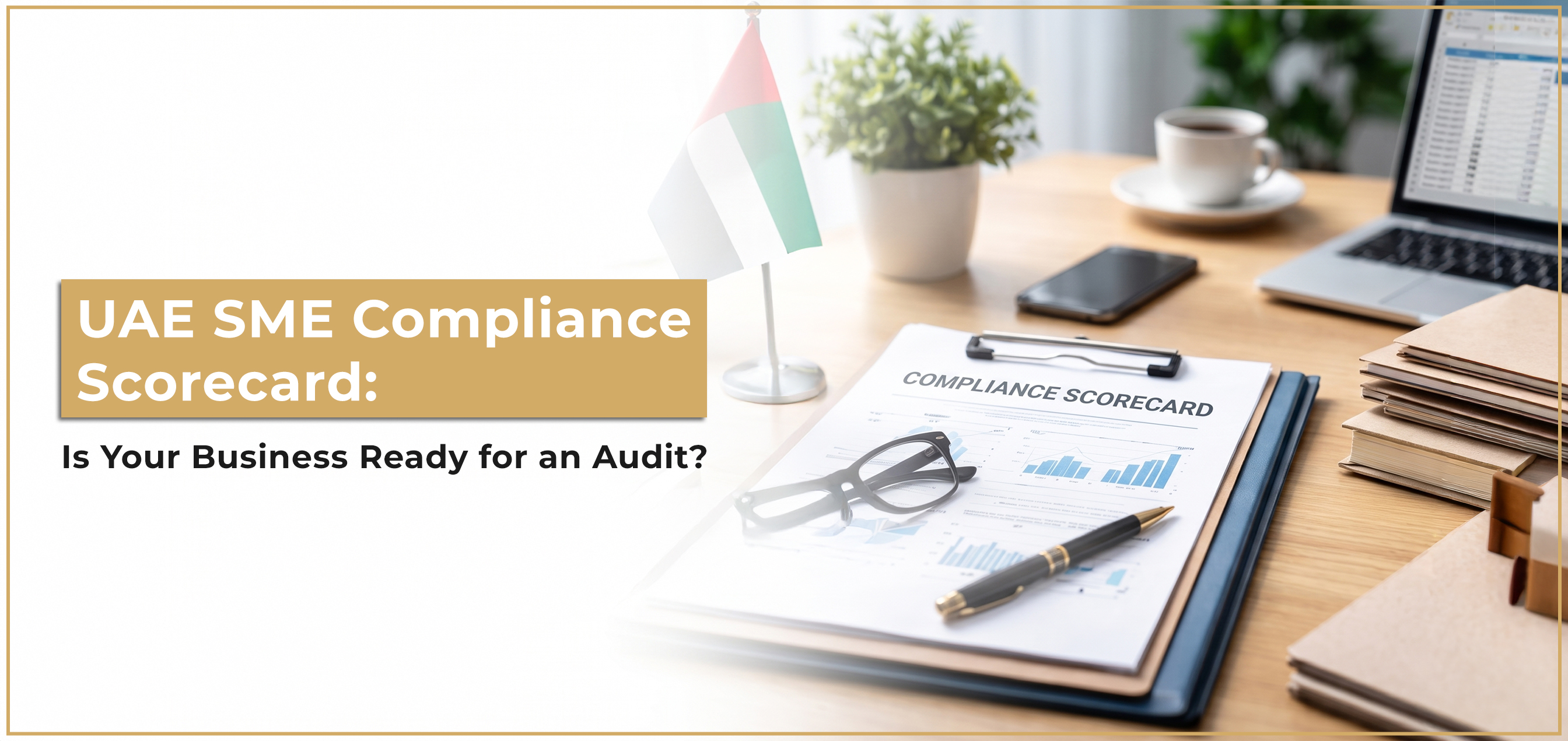
How the SME Audit Readiness Scorecard Works
Review each section and ask:
-
Is the required documentation available?
-
Is it complete and up to date?
-
Can you provide supporting evidence quickly?
Score each section:
-
1 point: Complete and audit-ready
-
0.5 points: Partially complete
-
0 points: Missing or substantially incomplete
A higher score indicates stronger SME audit readiness UAE. Use the result to identify areas that need attention before your audit. This scorecard is an internal readiness tool, not a legal compliance test.

1. Accounting Records and Financial Reporting
Check that your business maintains a complete general ledger, trial balance, financial statements, bank reconciliations, AR/AP schedules, and supporting records. Your accounting records should reconcile with your invoices, bank statements, and tax records.
Under UAE tax legislation, taxpayers must retain accounting records, tax records, and supporting documents for the prescribed retention period. Records must be maintained in a manner that enables the Federal Tax Authority (FTA) to verify tax obligations, including during a tax audit or review. Businesses should ensure that records are complete, accurate, accessible, and available for inspection when required — see AMCA's guide on essential accounting records UAE companies must maintain for the specific retention periods involved.
Score: 1 = complete | 0.5 = minor gaps | 0 = incomplete
2. VAT, Excise, and Corporate Tax
Review VAT, Excise and Corporate Tax registrations, returns, invoices, payments and supporting records. Reconcile tax filings with your accounting records and ensure required documents are retained.
Score: 1 = fully reconciled | 0.5 = some gaps | 0 = major gaps
3. Corporate, Legal and UBO Documentation
Ensure your trade licence, MOA/AOA, shareholder details, UBO information, statutory registers and corporate resolutions are current and properly maintained.
Score: 1 = current | 0.5 = updates pending | 0 = incomplete
4. Banking, Accounts Receivable (AR), Accounts Payable (AP) and Transaction Records
Keep bank statements, reconciliations, AR/AP ageing reports, invoices, contracts, purchase orders and payment evidence organised and traceable.
Score: 1 = fully supported | 0.5 = some investigation needed | 0 = missing records
5. Payroll and Employee Records
Check payroll registers, employment records, WPS records where applicable, leave balances, end-of-service calculations and payroll reconciliations.
Score: 1 = reconciled | 0.5 = minor gaps | 0 = significant gaps
6. Fixed Assets and Inventory
Maintain updated fixed asset registers, depreciation schedules, purchase and disposal records, inventory listings, stock counts and inventory reconciliations.
Score: 1 = reconciled | 0.5 = needs review | 0 = incomplete
7. Internal Controls and Supporting Evidence
Review payment approvals, segregation of duties, bank reconciliation reviews, management reporting, system access and document-retention procedures. AMCA's free internal audit checklist for UAE businesses is a useful companion for this section specifically.
Score: 1 = documented and effective | 0.5 = informal | 0 = weak or missing
8. Contracts, Loans and Significant Transactions
Keep major customer and supplier contracts, leases, loans, financing documents, related-party agreements and supporting evidence for significant transactions. These records can also support Corporate Tax transfer pricing disclosures and related-party reporting, where applicable, giving SMEs a reason to maintain complete documentation beyond audit requirements.
Score: 1 = fully supported | 0.5 = some follow-up needed | 0 = inadequate evidence
How to Calculate Your UAE SME Audit Readiness Score
Add your scores across the eight sections.
7–8 points: Strongly prepared
Your business appears to have a solid foundation for audit readiness UAE. Continue monthly reconciliations and maintain your documentation rather than waiting for the audit period.
5–6.5 points: Needs improvement
Your records are reasonably established, but several areas should be strengthened before the audit. Prioritise unreconciled balances, missing documents and tax reconciliations.
Below 5 points: Significant preparation required
Your business may have material documentation or control gaps. Address the highest-risk areas first and consider obtaining professional support before the audit begins.
Remember that this score is an internal readiness indicator, not a substitute for an auditor's professional assessment.

Is My Business Audit Ready? Ask These 10 Questions
If you are still asking, is my business audit ready, answer these questions:
-
Are my books closed and reconciled every month?
-
Do my bank balances agree with the accounting records?
-
Can I support every major revenue and expense transaction?
-
Are VAT records reconciled with the ledger?
-
Are Corporate Tax records and calculations properly supported?
-
Are my UBO and corporate records current?
-
Are payroll and employee-related liabilities reconciled?
-
Does my fixed asset register agree with the balance sheet?
-
Can I produce contracts for significant transactions?
-
Can my finance team provide requested documents without a last-minute search?
If several answers are "no", your SME audit readiness UAE score probably needs improvement.
Common Compliance Gaps That Cause Audit Problems
Some of the most common issues SMEs should look for include:
-
Unreconciled bank accounts
-
Old unexplained receivable or payable balances
-
Missing invoices
-
Incomplete contracts
-
Unsupported journal entries
-
Differences between VAT returns and accounting records
-
Outdated corporate information
-
Incomplete UBO records
-
Missing fixed asset documentation
-
Payroll differences
-
Weak approval controls
-
Poor document retention
These issues can make it difficult to answer the question how do I know if my SME is ready for an audit in UAE with confidence.
The solution is not necessarily more paperwork. It is a structured review of the records your business already maintains.
What Documents Should You Prepare Before an Annual Audit?
Create an audit folder containing at least:
-
Trial balance
-
General ledger
-
Annual financial statements
-
Bank statements
-
Bank reconciliations
-
AR/AP ageing reports
-
VAT returns and supporting schedules
-
Corporate Tax records and filings
-
Tax registration documents
-
Trade licence
-
MOA/AOA
-
UBO information
-
Payroll records
-
WPS records, where applicable
-
Fixed asset register
-
Inventory records
-
Major customer and supplier contracts
-
Loan and lease agreements
-
Related-party transaction documentation
-
Board and shareholder resolutions
Maintaining these documents throughout the year makes audit readiness UAE much easier than reconstructing an entire year's records immediately before the auditor arrives — AMCA's overview of the audit process in Dubai shows how this documentation feeds into the actual fieldwork.
How Can an SME Improve Audit Readiness?
Improving audit readiness UAE does not require waiting for the next audit.

Use a monthly process:
Step 1: Close the books
Complete bank, AR and AP reconciliations.
Step 2: Review tax records
Compare VAT and Corporate Tax information with the accounting records.
Step 3: Check supporting documents
Investigate missing invoices, contracts and payment evidence.
Step 4: Update corporate records
Review licences, shareholder information and UBO records.
Step 5: Review controls
Check whether important payments and transactions have appropriate approval.
Step 6: Run a mock audit
Ask an independent finance professional to identify gaps before the statutory audit.
This approach transforms an SME compliance checklist UAE from a year-end document into a practical management system.
Stay Audit-Ready With AMCA Auditing
Audit preparation should not become a last-minute scramble. A proactive audit readiness checklist UAE approach gives your business time to reconcile accounts, correct errors, obtain missing documents, update corporate records and strengthen internal controls before the auditor arrives.
AMCA Auditing helps UAE SMEs identify and address potential compliance gaps across accounting records, financial statements, VAT and Corporate Tax records, UBO documentation, bank reconciliations, AR/AP, fixed assets, inventory and internal controls. As an experienced audit firm for SMEs Dubai businesses can rely on, we help you organise your records and prepare for the audit with greater confidence.
Whether you need an audit firm for SMEs Dubai companies can approach for professional support or broader audit UAE services, our team focuses on identifying gaps before they become audit findings.
If you're wondering is my business audit ready, use this scorecard to identify areas that need attention and take action before your next audit.
Ready to strengthen your audit readiness UAE position? Contact AMCA Auditing today for a professional audit-readiness review.
FAQs
1. How do I know if my SME is ready for an audit in the UAE?
Check whether your accounting, tax, corporate and supporting records are complete and up to date. Use the scorecard above to identify gaps.
2. What compliance does an SME need in the UAE?
It depends on the business structure, activities and tax position. Key areas include accounting, VAT, Corporate Tax, corporate records, UBO information and payroll.
3. What are the main SME audit requirements in the UAE?
SME audit requirements UAE include maintaining proper accounting records, preparing annual financial statements and meeting applicable audit requirements under UAE company law and, for Corporate Tax purposes (where applicable).
4. How can an audit firm help an SME?
An audit firm for SMEs Dubai businesses can help review financial records, identify compliance gaps, strengthen controls and prepare your business for its next audit.